
PHOTO
Can a rail trail and heritage rail travel co-exist on the Monaro? This question has sparked much debate among community organisations on either side of the line.
Advocates for the Monaro rail corridor to be preserved for heritage rail use are hoping a new report will change Snowy Monaro Regional Council’s stance that a rail trail and operational rail line are both feasible options.
At its March council meeting, councillors voted against a rescission motion to overturn a decision to start constructing a section of the Monaro Rail Trail at Bombala.
In February, council voted six to five to start building five kilometres of rail trail at Bombala.
The trail would run from the Bombala township, north along the rail corridor. Council debated a motion for more than two hours in February, before deciding to build the trail along the rail corridor.
A new economic report suggests the Queanbeyan–Bombala railway corridor could inject more economic activity in the Snowy Monaro if heritage rail tourism and recreational trail infrastructure were developed together.
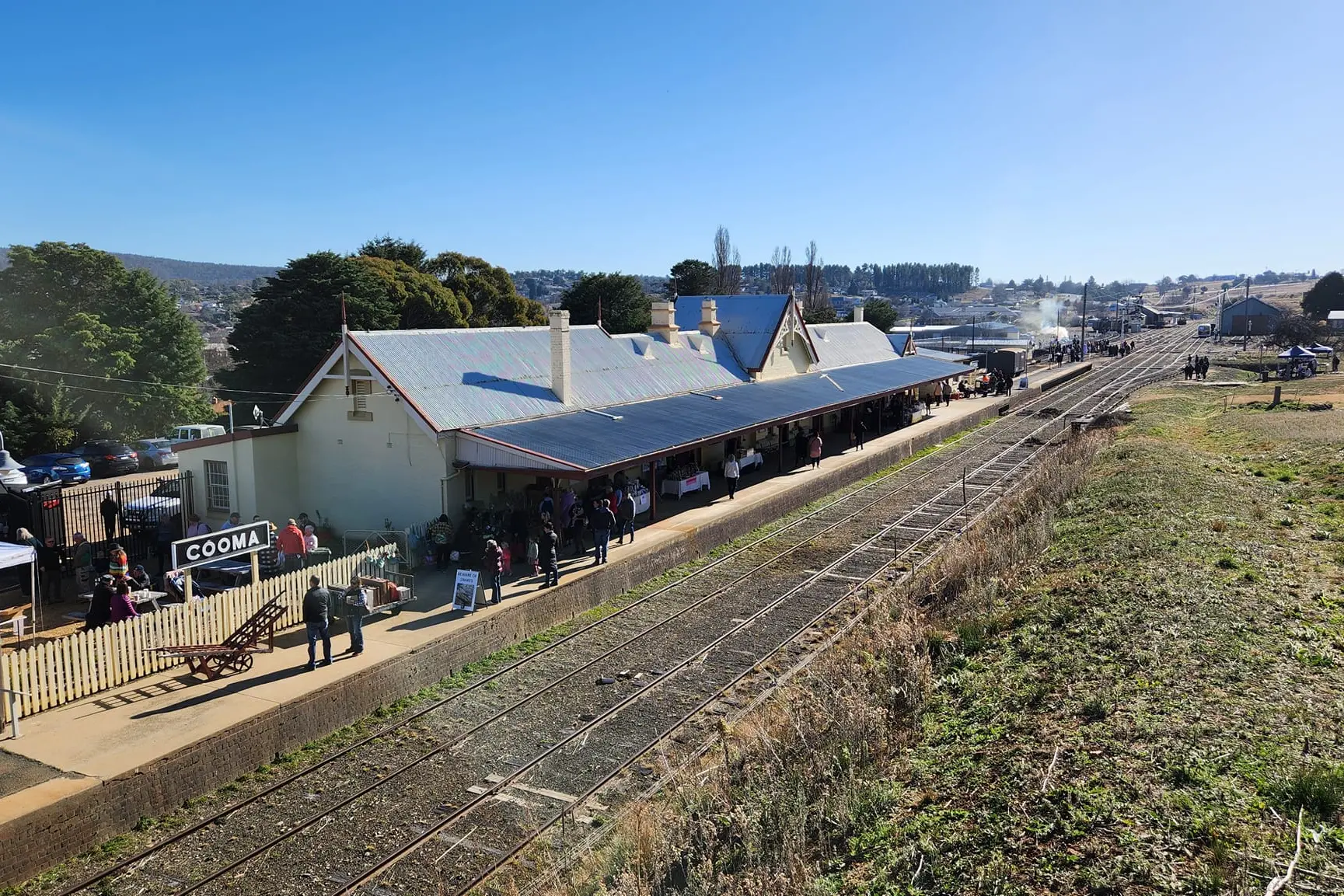
Cooma Monaro Railway (CMR) has released an economic impact assessment examining two potential development pathways for the 213-kilometre rail corridor linking Queanbeyan, Michelago, Bredbo, Cooma, Nimmitabel and Bombala.
CMR is an advocate for heritage trains to return to the Monaro rail corridor.
President, Gordon Strachan, said the report was intended to contribute to the broader discussion about how the corridor could deliver the greatest long-term benefit for the region.
“The rail trail proposal clearly demonstrates the tourism potential of the corridor,” Mr Strachan said.
“What our analysis suggests is that if the region can support both cycling tourism and heritage rail tourism, the overall economic return could be significantly greater.”
The report suggests the Monaro Rail Trail could generate $29 million annually to the visitor economy.
The report states a shared rail and trail corridor enabling both rail tourism and cycling tourism could increase regional tourism activity to between $50 million and $60 million per year, effectively doubling the economic productivity of the corridor.
Mr Strachan said the report was not intended to oppose rail trail development, but to highlight the potential economic advantages of exploring a shared corridor approach.
“The question for the region is not whether tourism development should occur,” he said.
“The real question is how this important public asset can deliver the greatest long-term economic benefit for the Snowy Monaro region.”
Mr Strachan said he hopes council reconsiders its position to use the existing rail corridor at Bombala for a rail trail.
“There is understandable interest in progressing a rail trail at Bombala. However, recent commentary suggesting that the matter is already settled does not fully reflect the complexity of the decision before the community,” he said.
“The Monaro rail corridor is a state-owned rail asset that has not been formally closed and continues to support existing and developing heritage rail operations.
“As such, decisions about its future extend beyond the remit of council and require careful assessment by Transport for NSW.”
Proponents believe once the rail infrastructure is taken away, it won’t be replaced or reused.
“While the current proposal focuses on a five-kilometre section, it forms part of a much larger corridor,” Mr Strachan said.
“Choices made now will shape the long-term integrity, use and potential of the entire line, not just a single stage.
“Some have suggested that rail infrastructure can simply be ‘set aside’ and preserved.
“In practice, once track is removed, operational rail capability is lost. Reinstatement later becomes significantly more difficult, costly and uncertain.”
Snowy Monaro Regional Councillor, Cr Bob Stewart, said he is pleased council will progress with the rail trail at Bombala.
“The rail trail was kicked off to support the battling communities of the Monaro. We need to give a boost to our communities, particularly Bombala and Nimmitabel,” Cr Stewart said at the February meeting.
Monaro Rail Trail group chair, Frank Bakker, applauded council’s support of the motion.
Mr Bakker said his organisation has been working-hard with council to progress plans, reports and supporting documentation to see a business case prepared.
“Council has already made an important start towards establishing the rail trail with construction of the first four to five kilometres section of the trail from Bombala commencing in the near future,” Mr Bakker said.