
PHOTO
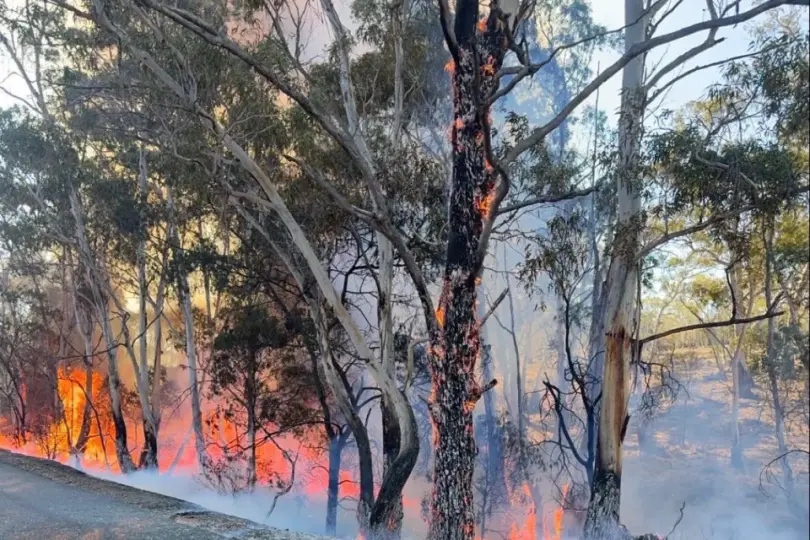
A local rural fire brigade captain, and member of a Monaro African Lovegrass (ALG) working group, has provided a response on the Snowy Monaro region’s Bush Fire Risk Management Plan (BFRMP) currently open for public feedback.
The draft plan outlines how local fire agencies and land managers intend to manage bush fire risk, including planned hazard reduction and community protection strategies.
The plan, designed to last five years, includes mapping of high-risk areas, identification of assets at risk (homes, businesses, infrastructure) and proposed treatment strategies (hazard reduction burns, mechanical clearing).
Ant Waldren, the captain of Nimmitabel Rural Fire Brigade and Kybeyan landholder, is one of a number of locals in an ALG working group established six years ago to lobby government and departments to remove crippling legislation that inhibits Monaro farmers from farming out the ALG scourge in the region, which creates a highly flammable base for fire.
Mr Waldren said the plan should encompass communities under high threat of fire risk from intense ALG grass fires, including Dalgety, Berridale and Cooma.
“The mass increase in spread each year of high infestation ALG will make other Monaro villages priorities as under high fire threat from ALG, plus the whole area of now more than 150,000 Ha high infestation ALG on the Monaro must be recognised as a major fire risk,” mr Waldren said.
NSW Rural Fire Service district co-ordinator Snowy Monaro, Ross Smith, said the contributions of the ALG working group and others to the risk plan is highly valuable community engagement on fuel management.
“ALG is a challenge in its risk profile,” Mr Smith said.
“It’s one of many hazards our planning accounts for. Our BFRMP assesses fuel risk across all vegetation types, African Lovegrass included.
“The tools we use to manage it, hazard reduction burning, mechanical treatment and asset protection, are the same tools applied across the full range of fuel types we deal with in this district.”
Mr Waldren said the fuel management treatment strategies suggested in the plan will not achieve much in keeping community and environment safe.
“Although well meaning, they will only cover a fraction of the high risk area of property and environment at risk of being over run by fire from the yearly expanding bio mass of ALG,” he said.
Mr Waldren added Monaro communities need a 10-kilometre ALG and timber fire safety managed buffer zone, with key performance indicators attached to significantly reducing ALG fuel load and timber fuel threat in these areas.
“This will reduce the high risk of Monaro communities and environment being over run by fire, and as a result, increasing the chance of separate fires joining up into a mega-fire,” he said.
“National Parks and Wildlife Service [NPWS] also needs to prioritise yearly trail maintenance of all trails on their boundary to substantially reduce the risk of fire entering or exiting the parks.”
Mr Waldren has called on the Bush Fire Management Committee (BFMC) to consult with the ALG working group to promote substantial farmed buffer zones around Monaro communities like Bredbo.
He said boom spraying paddocks of high infestation ALG in these buffer zones, and then planting vigorous growing exotic species with high fertility input and ensuring rotational grazing management with every effort to maintain high levels of ground cover will give community, fire fighters, farm and native animals a safe zone to go to in extreme fire conditions.
“Also these areas are the basis for isolating fires from substantial spread,” he said.
“The BFMC should pro-actively support the working group to lobby government and departments on having only regulation on high conservation value native grasslands, with zero per cent ALG infestation, as even infestations of 0.5 per cent ALG per Ha such as on Radio Hill is costing Snowy Monaro Regional Council $310 per Ha to spot spray.
“This cost level is unsustainable, as farmers are only earning $30 per Ha on land with 0.5 per cent Ha ALG. Therefore it is lost, and needs boom spraying to stop this infestation becoming high infestation ALG within seven to 10 years.”
The working group has suggested the establishment of lineal fire trails around towns and regular maintenance of existing trails each year to protect local communities and give fire fighters, in the right conditions, a better chance of quickly isolating fire outbreaks.
“Also yearly mitigation of trails with chemical boom spraying is desperately needed by RFS, to cover maximum trail maintenance at incredibly low cost to government compared to expensive dozing and grading trail maintenance,” Mr Waldren said.
“Chemical boom spraying is standard ethical practice by NPWS and Forestry NSW. However RFS substantial pushback to chemical fire trail maintenance has put volunteers at unacceptable risk trying to traverse unmaintained trails, because the minimum trail maintenance budget covers a lot fewer trails due to choice of higher cost trail maintenance methods.
“The current yearly average spend of $1million on trail maintenance of RFS trails across the state, compared to previously $41million.
“This putting fire fighters at unacceptable risk, as a large number of trails on the Monaro are having fire controllers needing to call in plant to get access to already burning fires.
“We need to all work together to prevent the mass risk to community, environment, economy and land holder mental health caused by the ALGepidemic.”
Mr Smith said the BFMC will work through submissions with land management agencies and partners and make sure that important feedback forms part of the ongoing way the NSW Rural Fire Service co-ordinates risk management approaches across the BFMC area.
Feedback on the plan is open until Monday 25 May. Landholders are encouraged to have their say.