
PHOTO
78321.0
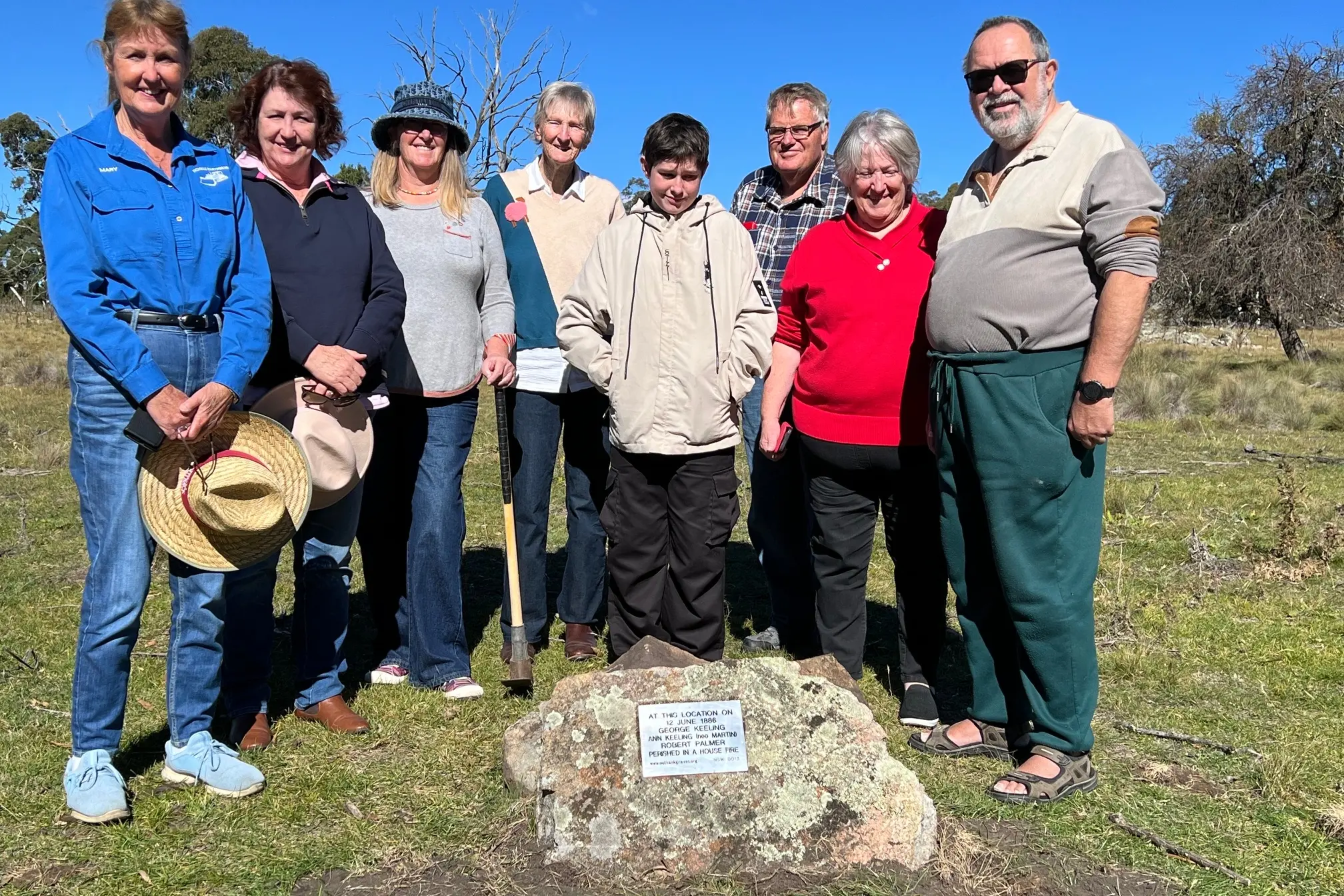
Family members of former Coolringdon Station residents who perished in a house fire in 1886 gathered in May for the official unveiling of a plaque at the site of the tragedy.
The site, located in “Keelings Paddock”, forms part of the historic grazing property, which has strong links to the earliest European settlement of the Monaro district in the 1830s.
The plaque inscription states: “At this location on 12 June 1886 George Keeling, Ann Keeling (nee Martin), Robert Palmer perished in a house fire”.
Ann was a housekeeper and her husband, George, a boundary rider, at Coolringdon.
The coroner, Mr FB Monague, held an inquest on the remains of George Keeling, Ann Keeling and Robert Palmer.
The coroner’s report, published in the Monaro Mercury and Cooma and Bombala Advertiser, 16 June 1886, revealed:
“Sub-inspector Baker of police stationed at Cooma sworn testimony - “On Saturday evening about a quarter to seven James Williams reported to me that George Keeling’s house was burnt to the ground and he saw some charred white bones among the remains; next morning in company with the Coroner, I proceeded to the place about half a mile from Coolringdon home station, I then saw the remains of a house that had been burnt to the ground; the sheets of iron were on the bodies, which were then smouldering...”
“James Williams, overseer on Coolringdon Station, sworn: “I met Robert Palmer before sundown on Friday evening about two miles from Coolringdon on the Cooma road. Palmer appeared to be quite sober, about half-past 3 O’clock on Saturday afternoon I came home by way of Keeling’s and his place was burnt to the ground....I went to see her son Murdoch McMahon to see if his mother had been there. She had not. We returned, we shifted a sheet or two of iron and saw a heap of bones, we then went and reported the matter to the police....The house was ceiled with pine and papered...the place was not insured, it was owned by Mr David Ryrie and worth about pounds 50. Murdoch McMahon was with me when I met Palmer and told me who the old man was.”
“Murdoch McMahon, labourer, residing at Coolringdon sworn: “ I am a son of Mrs Keeling one of the deceased. I got up about 4 O’clock on Saturday morning and heard a tree falling when at my own place round the hill here. I looked around in the direction of my mother’s place and saw a smoke. I went to bed again. On Saturday evening Williams asked me if I saw my mother. I said no. He said “the house is burnt to ashes”. The old man (Keeling) was in the habit of setting fire to the trees to get fire wood, and I came to the conclusion that one of the trees came crashing down. I went with Williams to see the house which was burnt to the ground...I was with Williams when we met Palmer, he was not under the influence of liquor and he offered us no grog. I saw no drink with him. My mother’s age was about 59 years. I knew Palmer to speak to, my mother used to take a drink occasionally. Keeling (age 70) was addicted to drink.”
“Kate McMahon, wife of Murdoch McMahon sworn: “Robert Palmer called at my place about 5pm on Friday evening, he asked to be directed to George Keeling’s...I do not think Palmer was under the influence of drink but he said he had a drop of grog...”
“Emma Gracie, wife of Joseph Gracie at the Royal Hotel, sworn: “Palmer called at my place between 1 and 2pm on Friday and I served him with a bottle of rum. He left my place sober. He put the bottle of rum in a pack on the horse and took it away.”
“Dr Clifford swore: “I have seen what I take to be human remains in three parcels, those of two males and one female. I cannot tell the ages, the remains are so charred. None of the bones are whole.”
The jury returned a verdict that they believed the remains found to be those of George Keeling, Ann Keeling and Robert Palmer and that there is no evidence to show how the fire originated.”
Family connections thanked Coolringdon co-trustee, Howard Charles, for his part in organising the day at Coolringdon.
The creation of the plaque itself is part of a project by a number of people within the region to restore and conserve grave sites, headstones and local history to maintain Cooma’s rich pioneering history.