
PHOTO
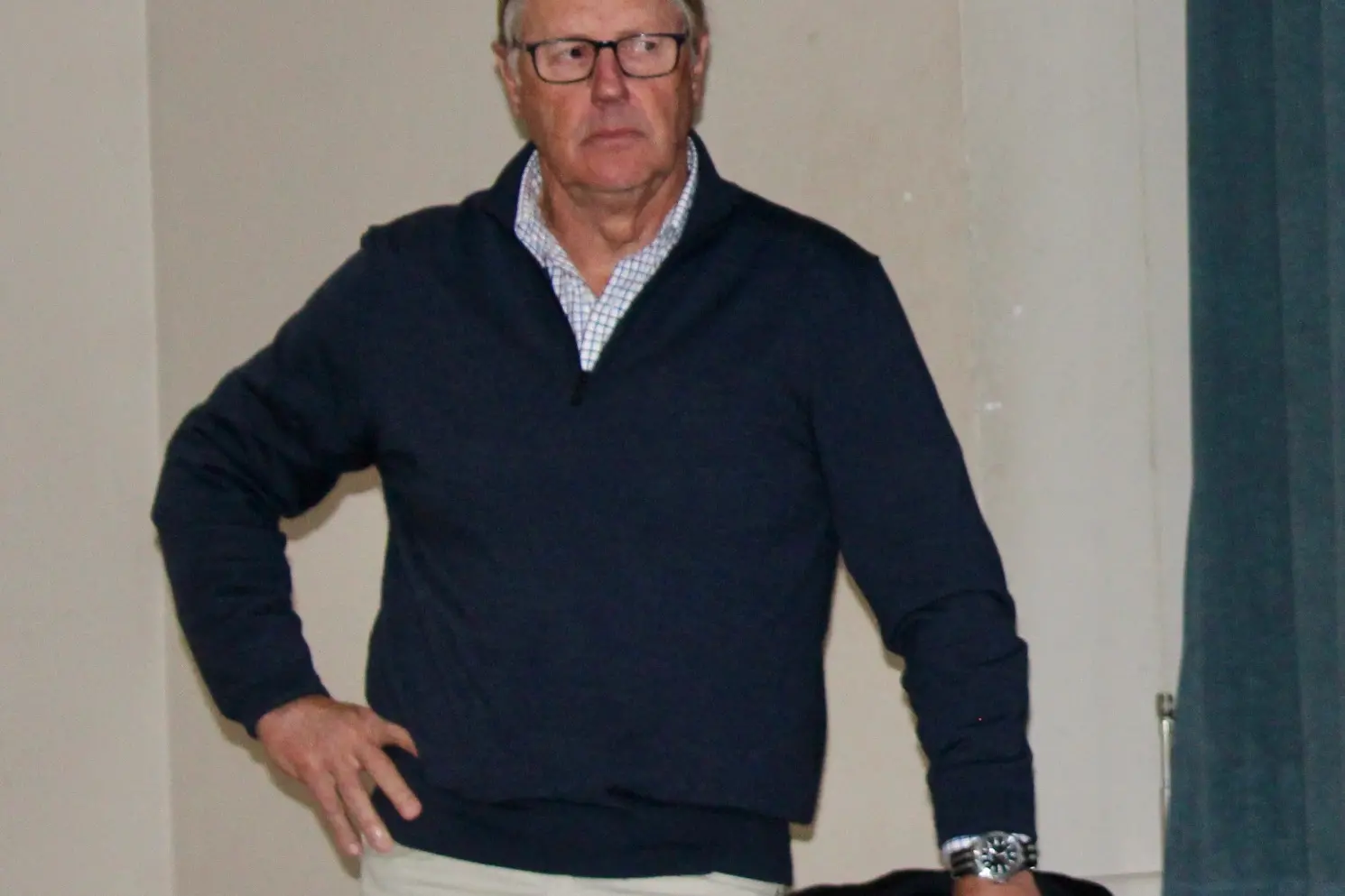
A recent community meeting in Bombala to address a growing concern of local farmland sales to corporate entities for carbon forestry projects (both environmental plantings and plantation forestry methods) featured forestry industry expert, Rob de Fegely.
Other speakers at the June meeting were local farmers John Murdoch, John Jeffreys and Ben Mooney.
Together they spoke to the community about concerns relating to a loss of productive farmland, reduced rural employment, outside corporate involvement and uncertainty about long-term impacts.
Mr de Fegely provided an insight into the regional forestry hubs established under the National Forestry Industry Plan 2018.
There are 11 regional forestry hubs across Australia. The forestry industry hubs work with industry, state and local governments and other key stakeholders to prepare and provide the government with strategic planning, technical assessments and analyses that aim to support growth in the forest industries in their region.
Mr de Fegely is the manager of the South East Forestry Hub, which supports forestry industries in southern NSW and the ACT to help grow a positive future for the region's communities and environment. He also sits on the board of Forestry Corporation NSW and chairs the Public Forest Agency in Tasmania.
Mr de Fegely began his career on the Monaro in 1980 growing radiata pine in the Coolangubra, Bucky Springs, Pericoe and Rockton areas.
"In my time as a career forester over 40 years, the challenge between farming and forestry has been around for a long time and it's history that we haven't actually blended together," he said.
"In Scandinavian countries and parts of Europe, you'll find that forestry and farming are very close neighbours and they work together really well."
He recalled however the years he spent in Bombala were productive and produced good outcomes.
"In the eight-and-a-half years I was here, when we were planting blocks that were basically cleared as farmland under early development in the late 1800s and early 1900s and for a raft of reasons those farms had become quite marginal mainly due to rabbits, the first World War, the loss of a generation of farm workers and then the Depression and again the second World War ... those poorer quality farms fell away and were purchased by a corporate entity from the Philippines. That was an interesting process as when re-developing those old farms in the mid-80s - by clearing all the tea trees and wattles - it suddenly looked like a farm again, but it was all granite soil and very low nutrient, so turning it back into forest was probably a sensible land use decision.
"I don't think in the eight-and-a-half years I was here, anyone seriously said to me I shouldn't be planting that pine. So pine and forestry and Bombala and farming had worked together really well in those early years," he said.
Mr de Fegely then pointed out challenges within the industry.
"The challenge has always been, despite the fact Australia is the seventh most forested country in the world, it is a net importer of wood products," he said.
"We import more than $7 billion worth of wood products a year. A lot comes from New Zealand, particularly pine framing. We get hardwood, particularly from Malaysia and the tropical rainforest, and we import paper products as well because all our paper mills have shut."
He said there are two drivers pushing the carbon debate at the moment, the first is a demand to be self-sufficient and secondly, achieving net zero such as carbon credits and cheap wood.
As South East NSW Forestry hub manager, Mr de Fegely said this government-funded scheme is designed to improve wood production, as Australia is not producing enough.
He said within the South East hub 60 per cent of the land is forest and 50 per cent of those forests are in national parks - by international standards a very high percentage.
"The United Nations is trying to get to about 30 per cent of terrestrial land in reserve, we've got 50 per cent. So we don't have a need for any more national parks in our region. Forestry corp in this region manages about 16 per cent of land. But the interesting thing is that 30 per cent of the forest is privately owned, that's over 840,000 hectares of private natural forest in our region, which could be managed and could be used to improve wood production. So if you ask me and I wanted to improve wood production in Australia, I would just go straight to the private sector.
"We don't need more plantation plantations," Mr de Fegely said.
"Some of it would work, but not a lot. We could do a lot more with our natural regrowth forest and we've done some work in the hub on this to show it is more profitable to manage your natural forest for hardwood products because it already exists - all you need to do is manage it.
"Even if you put in a plantation and got the $2000 grant plus carbon credits, your regrowth forest will still be in front, assuming that your Australian Carbon Credit Unit price is still reasonable - down around that $20-$30.
"The South East Forestry Hub has about a year to run. I have been talking about doing a project here in Bombala, because for me Bombala is special. I learnt a lot of my lessons for my career here.
"Bombala in some ways has unique characteristics, you are not overly influenced by other factors, so therefore getting farming and forestry right, would work really well here," Mr de Fegely said.
He said he did not want to see the carbon farming market create another social problem in the Bombala region similar to the Managed Investment Schemes (MIS), particularly in the forestry and timber sectors, boom in the 2000s which caused significant local economic disruption.
"The forest industry was tarnished by it. I hope we can move forward in a far better way," he said. "If we really think about how we can do this, we can end up with a good plan for the future."