
PHOTO
The Snowy Monaro District Rural Fire Service is embracing cutting-edge technology at its new district headquarters in Polo Flat, giving emergency crews faster intelligence, stronger communication capabilities and improved support during bushfires and other emergencies.
Opened earlier this year, the new headquarters features a significantly upgraded incident control room, designed to enhance co-ordination and decision-making during emergency operations. The Snowy Monaro facility is one of three new fire centres built across NSW in the past 12 months.
District Manager for the Snowy Monaro District, Superintendent Lachlan Gilchrist, said the larger and better-equipped control centre is a major step forward for local firefighting operations.
"The increased space within the centre makes a big difference, as the old building did not have the capacity for the layout that we now have in the new one," Superintendent Gilchrist said.
The modern facility incorporates advanced technology including AI-powered camera systems, thermal-imaging drones and expanded satellite connectivity to improve the detection, assessment and management of bushfires.
Superintendent Gilchrist said the NSW Rural Fire Service (NSW RFS) works on a similar concept to the military Australasian Interagency Incident Management System (AIIM). It relies on a scalable, chain-of-command structure that mirrors military organisation to ensure multi-agency co-operation during major emergencies.
"You have an incident controller who sets the tone and intent for the fire, deputy incident controllers look after various portfolios. So the room is laid out for all the functional heads with comms operators always up the front.
"Now that we are on centralised dispatch, we dispatch directly to the brigades and can track them because of all our data terminals in the trucks. A large proportion of the trucks have the Starlink attached to it, so we get perfect connectivity directly to the crew. This is managed as a dispatch arrangement. "Then we have operations, which involves our sits officer punching all the information gathered into an intel machine."
Additional operation team members include a public information officer who manages alerts and warnings to community, a safety officer and aviation comms and a "battle" desk where fire ground mapping happens plus a heavy plants section.
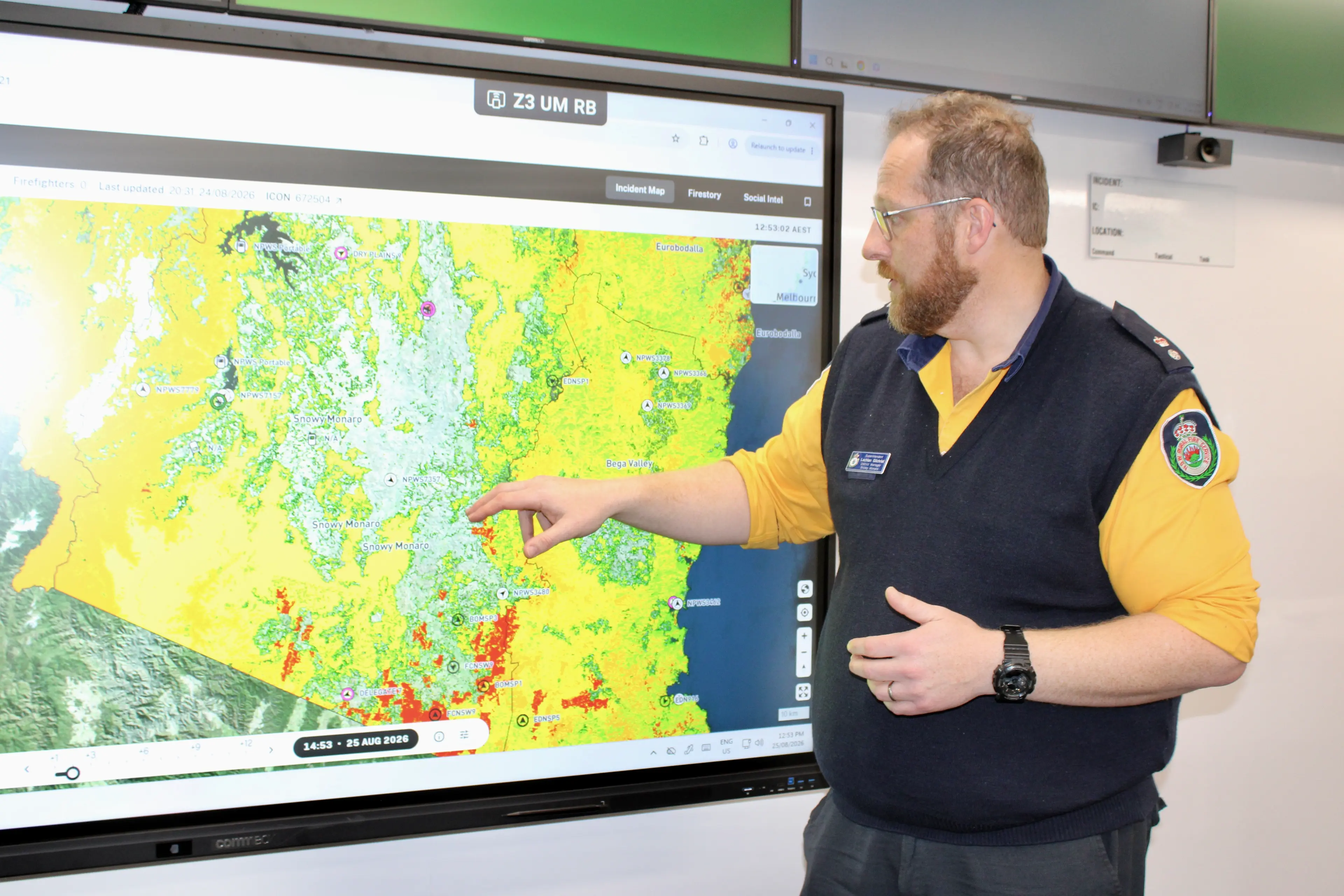
The intel gathering system, known as 'Athena', is one of the newest designed tools utilised in the modern-day incident control room.
Athena is an AI-driven bushfire intelligence platform developed by the NSW RFS in partnership with technology firm Kablamo following the devastating 2019-20 Black Summer bushfire season.
Athena acts as a software core that ingests multiple other state-of-the-art tech platforms. The system integrates with live field mapping technology and the Rural Fire Service's Airborne Intelligence Gathering data pipeline, reducing the processing time for thermal aerial imagery from around 30 minutes to less than two minutes.
"The part of this I really like is how it shows a map of current fuel loading across the Snowy Monaro district, and where problem areas are and where the impact would be," Superintendent Gilchrist said.
"We can see elevated curing areas, including the highway corridor, which is definitely a concern."
The platform can also identify vulnerable locations such as aged care facilities, hospitals and schools in real time, allowing planners to anticipate potential threats hours before they occur.
"This tech is really a game changer. It takes a bit of cognitive load off us so we can just focus on the fire."
Superintendent Gilchrist said the new technology demonstrates a huge level of investment in firefighting and keeping crews and community safe.
Beyond technology, Superintendent Gilchrist said the upgraded centre plays a critical role in supporting firefighters on the frontline.
"It might be chaotic elsewhere, but our job is restoring normality and that's very re-assuring to our people in the field to know that those in the headquarters who are having conversations on the radio, or the phone are calm and collected. They are the ones jumping into the trucks and going into the fires.
"They need that level of assurance that we are going to do it and we are going to do it safely."