
PHOTO
65756.0
Long-term resident of Jindabyne, John Graham, remembers his journey from England to the Australia and the memories he made along the way.
In the lead-up to ANZAC Day, Mr Graham reflected on the time he spent with Major Graham Pilcher, a significant player in the jute industry in Dundee, a second world war hero.
After completing a stint in the national service at the MC military camp in Burnham, New Zealand in 1956, before making the trek to Australia where he ran a ski chalet in Charlottes Pass.
Keeping close ties to his family history and in constant contact with his cousin Kirsty Pilcher, Mr Graham realised his cousin married into the famous Pilcher family and wanted to get to know them, especially considering his own military background.
Kirsty Pilcher married Robin Pilcher whose father was Major Graham Pilcher, Mr Graham learnt of the family ties and the first opportunity he got he flew back to England to meet the major and get to know him.
“We became quite close and would sit, tell stories and drink scotch together,” Mr Graham said.
Graham Pilcher, who has died aged 92, was a leading light in Dundee's textile industry, latterly with Sidlaw Industries Ltd, and was awarded the Military Cross in the Netherlands in 1944 while serving with the Black Watch.
In 1935, Pilcher completed a Territorial Army subaltern's course at Sandhurst and was commissioned into the 4th/5th Battalion the Black Watch, eventually becoming the battalion signals officer.
He was mobilised with the 4th Battalion in September 1939 and accompanied them to France the following January as part of the 51st Highland Division.
The battalion became part of Ark Force and escaped from Cherbourg on June 15, 1940. Pilcher, who had been wounded, returned to England the same day in a hospital ship.
He then spent two years with the battalion in Gibraltar and early in 1944 was in command of a camp in Hampshire where troops were training for the D-Day invasion.
Pilcher landed on D + 20 to join the 5th Battalion. He served as a company commander and two months later was wounded again but re-joined his men almost immediately. For the whole of the next year, the battalion was engaged in fierce fighting.
On October 25, 1944, the battalion crossed the river Dommel near the village of Esch, south of Hertogenbosch, to expand the bridgehead.
Pilcher's company came under heavy mortar and Spandau fire at close range and was pinned down in flat, open country.
Any movement out of the cover of the ditches drew fire, and men were being picked off by snipers.
Pilcher realised that the situation was critical and ran across the open ground to his forward units.
Despite coming under intense fire, he organised and led a determined assault on the enemy who were dug in on the main road 200 yards away. Two enemy machine-gun posts were wiped out and several enemies killed and captured.
The sniping continued and Pilcher crossed and recrossed the bullet-swept ground consolidating his defensive positions. He was awarded an immediate MC and was decorated by Field Marshal Montgomery.
During the worst moments. he took comfort in reciting Kipling's If and singing to himself the music-hall ditty Mairzy Doats ("Mares sat oats and does eat oats").
Graham Hope Pilcher was born in Dundee on June 15, 1916, and educated at Craigflower School, Dunfermline, and Clifton College. Bristol, before joining Jute Industries Ltd in Dundee in 1935.
He was the fourth generation of his family on his mother's side to work in the industry and his father, W Hope Pilcher, was a director of the company.
In 1945, while staying with his grandmother in St Ives to recuperate from his wounds, he met Rosamunde Scott, who had been serving with the Wrens in Trincomalee in Ceylon.
They were married in December of the following year in Rosamunde's home church, St Uny's in Lelant.
They returned to Dundee where Pilcher resumed his work at Jute Industries Ltd and, over the next 34 years, became an increasingly important figure in the textile industry in Dundee.
When Mr Graham heard his old friend had passed away, he began planning his next trip over to England to visit his memorial place.
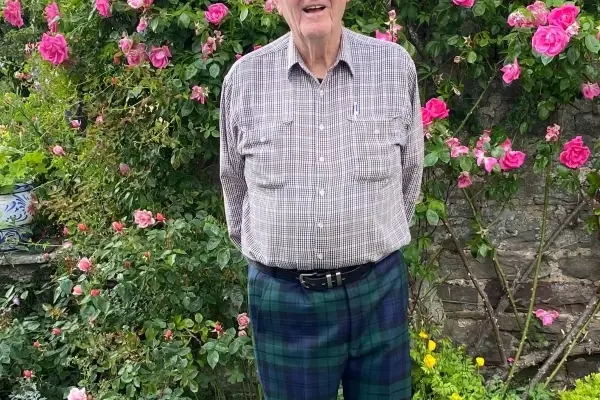
Last year, Mr Graham dressed in tartan trousers visited the major’s memorial site and other spots of significance to him and remembered him for all he had done and sacrificed for his country.
Mr Graham said it was a trip to remember and he will forever cherish the moments he shared with the major over a glass of scotch.