
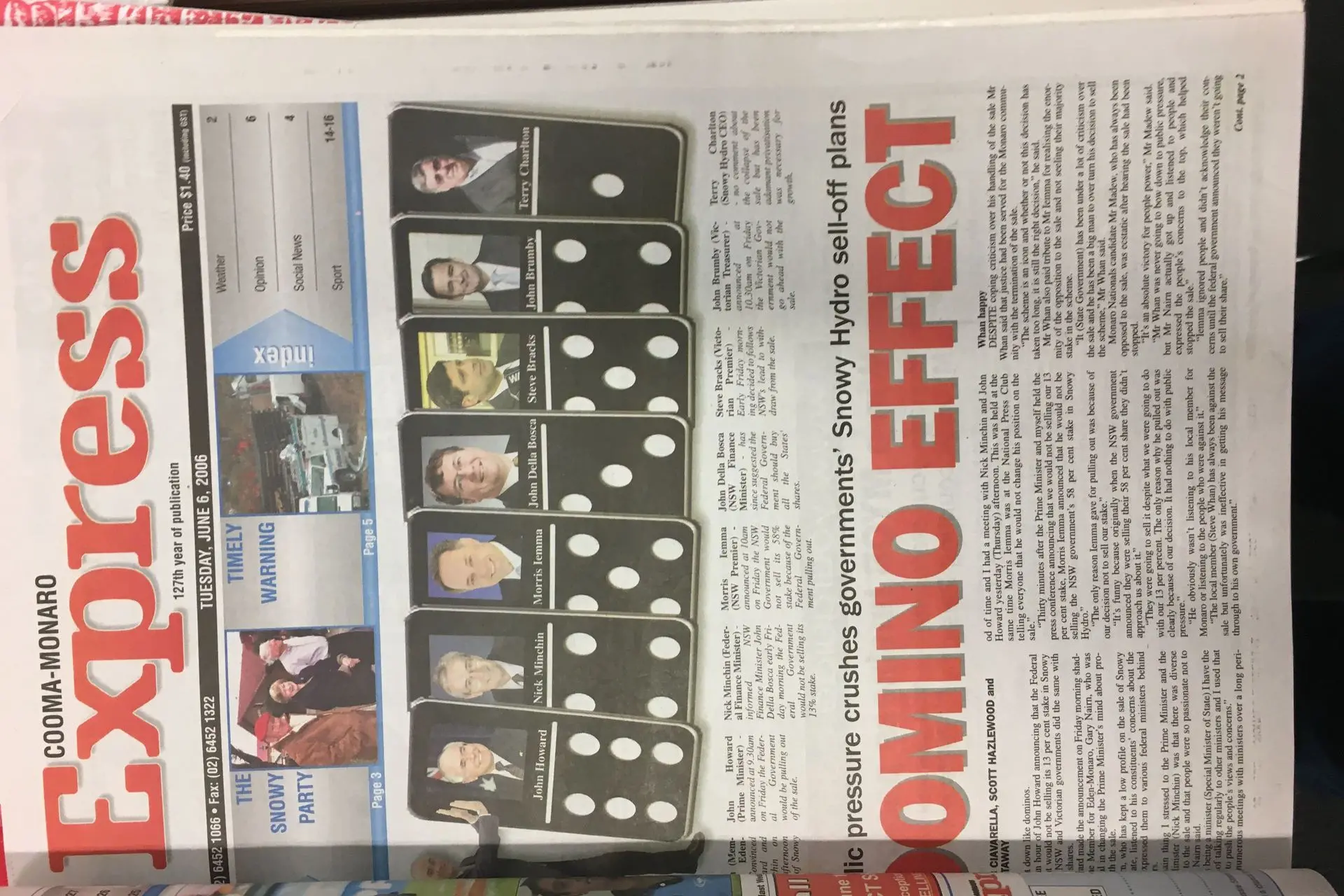
PHOTO
On 4 June, 2006, the power of the people and the media brought the Australian Federal Government to the realisation that selling off Snowy Hydro was not only not in the public interest but distinctly unpopular with ordinary Australians.
Prime Minister John Howard ended the privatisation proposal by withdrawing from the sale. This ended a six-month battle between the community and government.
On 19 December, 2005, NSW Premier Morris Iemma formally announced his government was intending to sell its 58 per cent share of Snowy Hydro. In February 2006, the Federal and Victorian Governments also agreed to the privatisation push.
That was before Save Our Snowy stepped up and a national media campaign swept across Australia. Save Our Snowy was a massive grassroots campaign opposing the proposed privatisation and sale.
The privatisation proposal was of concern to the mayors of Cooma Monaro (CMS) and Snowy River Shires (SRS), Roger Norton and Richard Wallace. Councils in Gippsland and irrigators in the Murrumbidgee Irrigation Area were also alarmed.
There had been a build-up of protest against the sale since January.
By February, public meetings were being held in Dalgety, Jindabyne, Orbost, Cooma, Canberra and East Gippsland.
During February and March, protestors bombarded print and electronic media, with opinion pieces, letters to editors, petitions, letters to MPs, editorials and spots on talkback radio.
On 20 April, a Save Our Snowy meeting was held at the Cooma Ex-Services Club, with more than 350 people in attendance.
Various speakers addressed the meeting, including NSW Finance Minister, John Della Bosca.
The overwhelming majority protested the proposed sale.
What followed was a virtual tsunami of anti-sale sentiment across the nation.
Anti-sale petitions grew rapidly while environmental and regional groups co-ordinated messaging. Phrases such as “selling the family silver”, “betrayal of the Snowy’ and “national icon” became commonplace in media reports.
Anti-sale activist, Acacia Rose, estimates about 1000 newspaper items were printed nationally between January and June 2006, with between 2000 and 5000 letters to editors printed.
Pressure intensified on politicians, especially the Member for Eden-Monaro, Gary Nairn, whose electorate was Snowy heartland. He faced immense voter backlash if the sale proceeded.
Premier Iemma ploughed on. In May, pre-registration for sale opened and while well supported, the float process increased public awareness and opposition.
However, the constant, vocal opposition from protestors such as mayors Norton and Wallace, ex-Snowy engineer Max and Coral Talbot, SRS Cr Vickii Wallace, former Snowy commissioner Vin Good, Acacia Rose and Lee Taylor-Friend were unrelenting.
Mr Nairn was quietly campaigning in the background and on 2 June, 2006, success.
Prime Minister John Howard announced the Australian Government would not sell its 13 per cent.
Twenty years on, those most vocal in the Save Our Snowy campaign are just as committed to the cause.
Max Talbot considered the proposal a betrayal of trust because “during the length of corporatisation negotiations we had assurances from both NSW and Victorian Governments that there was no intention to privatise the scheme in the future, that corporatisation was necessary for the scheme to participate in the National Electricity Market”.
“I and many others contacted politicians, state and federal on both sides of politics together with all the major newspapers,” he said.
“Community reaction at first was just disinterest but this changed following the community forum in Cooma organised by Save Our Snowy.”
Roger Norton said everyone involved in SOS “did a great job in getting Australia-wide support for SOS”.
“Gary Nairn was also a big player – he came to most public meetings. He had the ear of John Howard,” Mr Norton said.
Former Snowy worker, Charlie Salvestro, who said in 2006 the privatisation would have been disrespectful to those who lost their lives building the Snowy, holds the same opinion today – “I hope they never sell it”.
Acacia Rose, was one of the first to raise the alarm.
“My friend Peter Cocker noted a small article in the SMH stating that Snowy Hydro will be sold [this was prior to the announcement]. I knew that it was “on my watch” to do something,” she said. “The following day, I began to write letters to editors including the SMH and Australian Financial Review. At first, there was very little traction and suddenly, in January 2006, the media started to respond and pick up on the story.
“This is undoubtedly following the official announcement by Premier Iemma of the sale.”
Acacia’s main concerns about the sale related to the Snowy Scheme as a “key infrastructure asset”.
“Snowy was and is central to water and energy security, and as such, forms a part of Australia’s essential infrastructure. Snowy was built under the Defence Act and remains integral, central to domestic energy and water supply,” she said.
Asked about key points in the campaign leading up to the sale failure, Acacia nominated the support of talkback radio, support from local and metropolitan media, the campaign waged by the late Lee Taylor-Friend and the efforts of Richard Wallace through the NSW Local Government Association, and the advocacy of Vin Good.
She also thanked Senator Bob Brown. “At some point in the campaign, I reached out to Legal Aid for legal advice about the legitimacy of the sale. Legal Aid declined to provide advice. “I then approached Senator Bob Brown who did seek legal advice. This effectively stated the proposed privatisation and sale of Snowy Hydro shares was illegal.”