
PHOTO
Snowy Hydro chief executive officer, Dennis Barnes, has told a Senate Estimates committee he expects Snowy 2.0 principal contractor, Future Generation Joint Venture, to deliver its revised costs for finishing the project by the end of June.
Mr Barnes fronted Senate Estimates last week where he was pressed for a figure on the costs of Snowy 2.0’s new enterprise bargaining agreement (EBA).
Liberal senator, Sarah Henderson, asked multiple questions of Mr Barnes, calling on the Snowy boss to provide the Environment and Communications Legislation Committee with an update on the Snowy 2.0 cost re-assessment and cost of the amended EBA.
“We are waiting for the line-by-line cost assessment from the contractor, and to speculate on an expectation would commercially prejudice this,” Mr Barnes said.
“In October last year, we said that we had directed the contractor to do a re-assessment which would take up to nine months.”
Senator Henderson said she found it ‘extraordinary’ Mr Barnes was not able to disclose the costs of the new EBA.
“When I have the report from the contractor, I will disclose the component of the cost increase for the project that’s related to the EBA, but I don’t have that figure today (Tuesday 26 May),” Mr Barnes said.
Mr Barnes did say increased wages and allowances have risen in the order of 20 to 25 per cent. He told the committee the $12 billion project budget would be spent by the middle of this year.
Liberal Senator, Dean Smith, asked Mr Barnes how far away from completion Snowy 2.0 is.
“Assuming the target date of the end of 2028 and the $12 billion figure, which, of course, we’ve said will be higher, we are just over 70 per cent complete. Obviously, completion and construction have a few definitions,” Mr Barnes said.
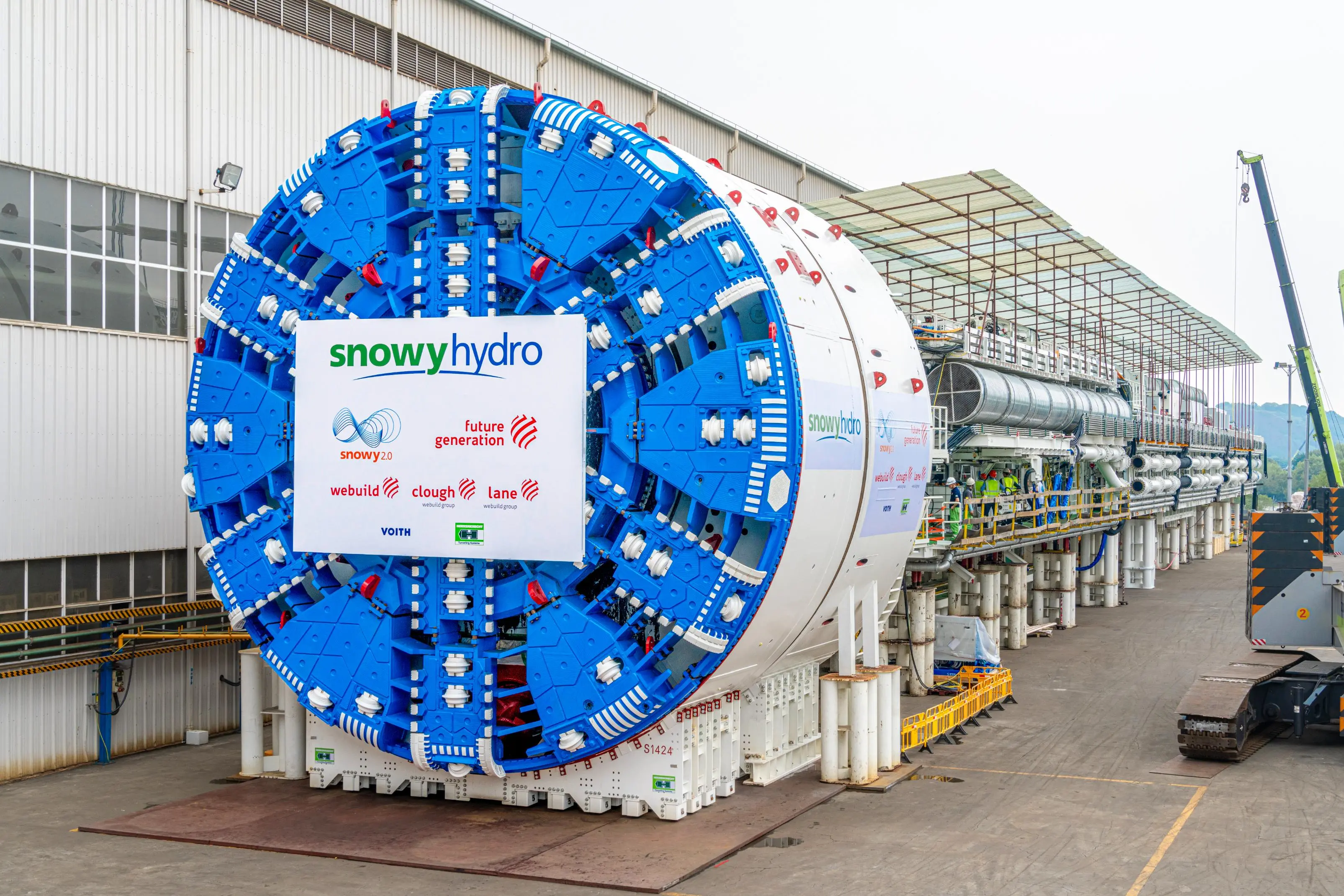
In his opening statement, Mr Barnes, said the project had recently achieved a significant milestone with the breakthrough of tunnel boring machine (TBM) Lady Eileen Hudson.
The TBM completed the six kilometre tailrace tunnel into the machine hall.
“Snowy 2.0 is connecting an upper reservoir to a lower reservoir through around 27 kilometres of tunnels with two massive caverns in between, about a kilometre underground, which will hold a power station the size of the Sydney Opera House,” Mr Barnes said.
“The breakthrough means we have now connected the lower reservoir to the power station cavern.
“Cavern progress is well advanced, and we’re getting set to begin power station construction, moving the project into a new phase.”
Senator Smith asked if Snowy Hydro would be willing to participate in a specific Senate inquiry into the project’s operations and costs.
Mr Barnes said ‘that’s possibly a question for others’.
Before Mr Barnes faced Senate Estimates, it was revealed in Snowy Hydro’s 2024-25 annual report the company’s top five executive staff received more than $1 million in bonuses last year.
Mr Barnes, was handed a short-term variable payment (performance based payment) of $322,504 in September 2025, on top of his $1.6 million yearly salary.
The payments came just a month before Snowy Hydro announced it had directed Snowy 2.0 principal contractor, Future Generation Joint Venture, to undertake a comprehensive re-assessment of the costs of delivering the pumped hydro project.