
PHOTO
67594.0
Snowmaking was the hot topic at the 2026 Snow Summit in Thredbo last week, with industry veteran Peter Brulisauer labelling it significant to the snow industry’s future.
Mr Brulisauer’s knowledge of snow is second to none; he was at the helm of Perisher and oversaw Vail Resorts’ Australian business. He is now vice president, International Business Development for Alterra Mountain Company.
His personal insight as a keynote speaker at the event was stirring, highlighting the realities, challenges and opportunities ahead.
“There’s only one reality and set of associated challenges and opportunities that I think are worth discussing,” Mr Brulisauer said.
He presented a series of charts and information showing the effects of the poor 2024 snow season, which not only affected all resorts’ revenue but also impacted the wider region’s economy through reduced visitation. Skier days were down 370,000 in 2024.
“When you attribute the greater value added, the cost to the economy of the bad season in ‘24 from the average is about $500 million. It’s a significant impact.”
He reflected on 2004, when then NSW Member for Monaro, Steve Whan, noted the impact of climate change on the Australian ski industry, particularly in NSW, would be devastating for the economy and for local regions.
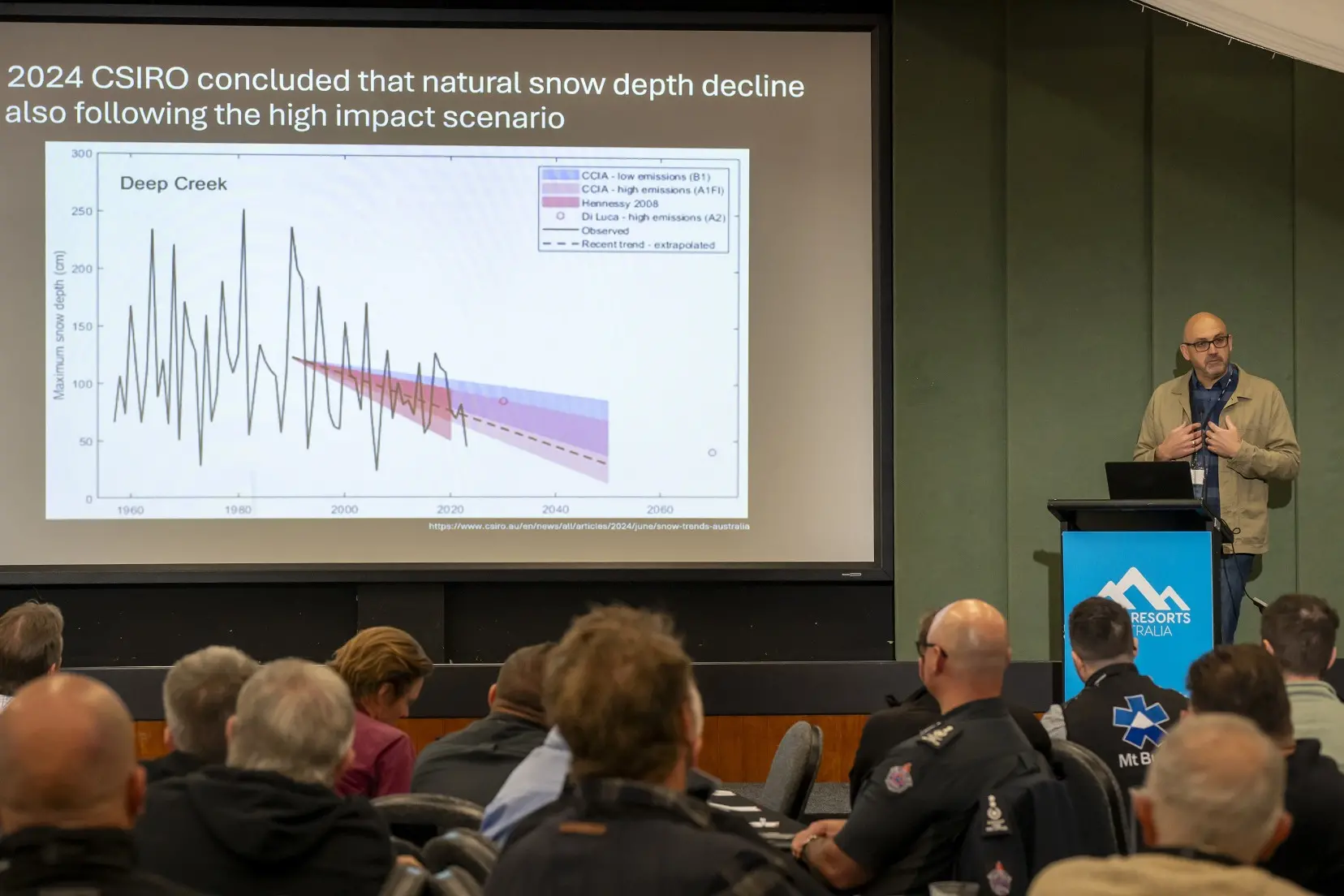
Mr Brulisauer said, as of 2025, Australia is tracking towards a high-impact zone identified in the 2008 CSIRO report outlining the effects of climate change on snow conditions.
He had questions about the long-term success of government investment in hiking and mountain biking for summer-season growth. The NSW government has invested about $50 million in the Snowy Mountains, and the Victorian government $32 million.
Comparing Australia and the world’s snow resorts, he noted our snow visitation is not growing, even though our population is.
Snowmaking is more prominent in most overseas resorts. Italian resorts have 90 per cent of their groomed trails covered in snowmaking. Citing an industry report, resorts covered with more modern snowmaking were able to continue providing a similar level of skier visits and resilience in the economy.
“Government support is needed to help alpine regions adjust. Is investing in more mountain bike trails the most effective way to minimise the impacts on mountain communities?”
Snowmaking has become essential, indispensable and impossible to imagine skiing without it.
“It’s the difference between open and closed,” Mr Brulisauer said.
In 2024, Italy’s Ministry of Tourism allocated 230 million euros to support cable car facility renovation, modernisation and artificial snowmaking systems. France, Switzerland and China provide government assistance to the snow industry.
“Given the generally strong return of income from snowmaking investments, but lack of major expansion in recent years, do the Australian resorts need government help to make investments in snowmaking to minimise the effects of climate change to protect regional economies, jobs and communities and the sport? Would that be appropriate?”