
PHOTO
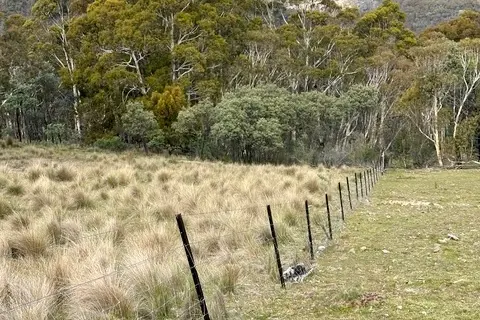
Serrated tussock (Nassella trichotoma) is one of the most significant weed problems affecting the Snowy Monaro region.
This drought-resistant perennial grass invades pastures, native grasslands, roadsides and other disturbed areas, making it a major agricultural, environmental and economic concern.
Local organisation, Snowy Brumby Horsemanship (SBH), is currently undertaking a serrated tussock trial using Brumbies to control the invasive weed.
SBH is a charitable organisation that primarily runs public wild horse training tours, horsemanship and riding lessons using its own special methods, but more recently the organisation has begun promoting the use of re-homed Brumbies as a weed-management tool, particularly for controlling serrated tussock on private properties in the Snowy Monaro region.
Multiple Snowy Mountains properties have adopted mobs of trained Brumbies for weed management. The horses have the ability to graze serrated tussock and access steep, rough terrain that can be difficult for conventional livestock.
SBH charity president, Sidonie Carpenter, said the trial is testing something under controlled, scientifically monitored conditions which the group has already observed informally on a number of other properties in the Snowy Mountains.
"We've seen Snowy Mountains Brumbies grazing serrated tussock, a weed of national significance that's considered unpalatable to livestock, and on those properties we've watched the tussock effectively disappear," Mrs Carpenter said.
The trial is being conducted in an area where the tussock has become resilient to sprays.
"For this trial we are using grazed and comparison plots, with methodology developed alongside an agronomist and guided by Dr Brian Sindel at the University of New England.
"If the data holds up, it gives government and the agriculture sector a genuinely new tool for a weed that's proven almost impossible to control by conventional means," Mrs Carpenter said.
Nine brumbies are on trial, grazing a paddock at Bannister (Southern Tablelands) with around 20 per cent serrated tussock cover. The whole trial is 20 acres in a 200 acre paddock. A neighbouring paddock, currently run with cattle, is being used as a comparison paddock.
The trial began on 1 June and runs through to 1 October, covering the winter growing season, which is when tussock control options are otherwise most limited.
"What we're doing is generating scientific evidence on tussock suppression using standard agronomic methodology, with university input and a clear path to peer-reviewed publication," Mrs Carpenter said.
"Serrated tussock costs the agriculture industry more than $40 million a year in NSW alone, and this trial is about giving government and the ag sector a properly tested option for dealing with that, not making a heritage argument."
Mrs Carpenter said there have been concerns expressed by people who have noted their domestic horses become sick from eating serrated tussock.
"I understand their concern," she said.
"It's true that most horses and livestock won't touch serrated tussock unless they're genuinely hungry, but I've personally watched my Brumbies choose to eat it.
"My horses get hard feed morning and night, they're not underfed, and over three years they've eradicated every bit of serrated tussock on our own property. My mare now pushes at the fence line into my neighbour's paddock, actively looking for tussock to eat," Mrs Carpenter said.
"We had an incident recently where an electric fence came down and the trial group got out. We took a Polaris down with a full bale of lucerne and a tub of pellets to bring them back into the grazing paddock, and they wouldn't come for it. That's not the behaviour of starving animals eating tussock because there's nothing else.
"There's good behavioural science behind why that's possible," she added.
"Animal behaviourist, Fred Provenza, has spent decades studying how grazing animals build a refined, individual palate through what he calls flavour-feedback learning, actively seeking out dozens of different plant species to meet their nutritional needs rather than just eating whatever pasture they're given. His book 'Nourishment' lays that research out. It fits exactly what I'm seeing in my own horses," she said.
A landscape architect and horticulturalist by profession Mrs Carpenter said what cannot be explained is how the Brumbies are eating serrated tussock with no ill effects.
"I'd love a vet science student to properly study this.
"My theory is that it may come down to gut microbiome differences built up through generations of browsing behaviour in the high country. It’s not just tussock either. I watch my Brumbies eat bramble, blackberry, thistle and yarrow, all introduced weeds, with no apparent problems.
"If a proper study confirms there's something physiologically different going on, that's a significant finding," Mrs Carpenter said.
Spreading seed through manure is another aspect of this method which has been questioned.
"On the seed question, I am yet to see this happen on our property or the other properties who have also seen their tussock eradicated. Maybe its because serrated tussock thrives in low-fertility, disturbed soil, which is actually why urea is used as a control method elsewhere.
"Horse manure is comparatively high in nutrients, and our working theory is that this may make deposited manure a poor environment for tussock seed to establish, even where the seed itself is technically still viable."
This is yet to be specifically tested, Mrs Carpenter said.
"It's one of the things this trial and future research will look at."
In March NSW Nationals MLC, Nichole Overall, visited Snowy Brumby Horsemanship in Dalgety to express her support for this weed management method, and observe Snowy Brumbies eat serrated tussock.
Mrs Overall, on behalf of the NSW Nationals in NSW Parliament, has spoken against the cull of the Brumbies in the Kosciuszko National Park and the repeal of the Kosciuszko Wild Horse Heritage Act 2018, an act passed by the NSW parliament under the former coalition government designed to "achieve a balance of conservation and culture and to manage humanely and transparently one of Australia's iconic living symbols, the Snowy Mountain Brumbies."
In her speech last October opposing the Kosciuszko Wild Horse Heritage Repeal Bill 2025 she noted the NSW Heritage Commissioner described the Kosciuszko brumbies as the most recognised wild horses in Australia, their image inseparable from the nation's identity.
Mrs Overall went on to state the commissioner declared "no other animal species in the country has ever received this level of formal heritage assessment".
"In a confirmation of the heritage status of the Snowy brumbies by the government's own commissioned research, there was no ambiguity. The government's own documentation confirmed that these horses are and deserve to remain formally recognised for their cultural, social and historical importance," Mrs Overall stated.
"Ultimately this is a matter of balance. Preserve the Brumbies, protect the environment, and respect local communities - and heritage and traditions.
"There are alternatives, community partnerships, and better and more humane ways," Mrs Overall said in her speech to parliament.
SBH spokesperson, Claire Rogerson, said the weed management trial will conceivably "give these once wild horses a purpose as the only solution to managing the invasive weed, serrated tussock, and thus giving each brumby a value beyond most horses".