
PHOTO
Australia’s current fuel issues are not just high prices - they are a combined supply, distribution and global geopolitics problem.
Distribution issues, high demand and global disruption are creating shortages and price spikes across the country, especially in regional areas.
Australia imports 70–90 per cent of its refined fuel, mostly from Asia, making it highly vulnerable to global shocks.
The farming sector is heavily dependent on diesel, prompting calls to the government to prioritise fuel for agriculture and regional areas as peak agricultural bodies warn that without diesel, food and livestock simply can’t move at all.
With the significant fuel (especially diesel) supply strain in Australia, farmers are among the hardest hit groups.
In the Snowy Monaro, farms (beef, sheep) need fuel every single day, not just seasonally, for feeding livestock, water pumping (especially in dry/cold periods), moving stock between paddocks and transporting animals to sale yards and processors.
Diesel shortages are disrupting daily operations and timing pressures mean production is at real risk. Flow-on effects include higher food prices and potential supply shortages. Fuel shortages are affecting delivery of fertiliser and feed, transport to processors and ports and supermarket supply chains.
Aside from the practical aspect, there is an emotional and financial stress weighing heavily on many farmers who feel a constant unease about supply and costs and concern about cash flow and debt if high fuel costs persist.
Anxiety about missing planting windows and losing income, with massive cost increases, are just a few concerns for some in the farming industry.
The supply chain pressure is real for local farmers as trucking companies (which move livestock and grain) are also struggling with doubling fuel costs and limited supply, tightening the whole agricultural supply chain.
Fertiliser supply (especially urea) has also been disrupted by the global conflict.
Australia imports 90 per cent of nitrogen fertiliser and 70 per cent of phosphate fertiliser meaning farmers must decide whether to plant less, reduce fertiliser use (lower yields) or accept much higher costs.
For crop and fodder suppliers in the local area there are multiple challenges in running this type of business.
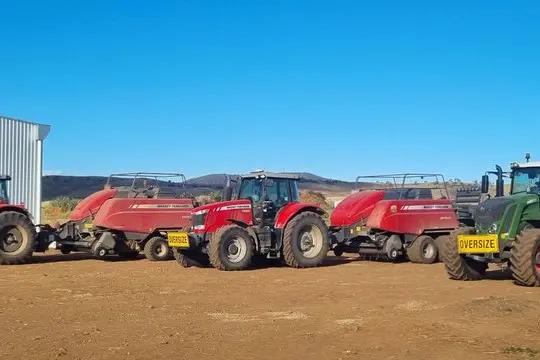
High Country Hay at Rose Valley, to the northeast of Cooma, managed by Josh Barron, supplies fodder into to the Far South Coast, Southern Tablelands and Monaro.
The business relies heavily on machinery, fertiliser and freight for day-to-day operations.
Josh said to the best of his knowledge the region’s service stations have been able to maintain a reasonable level of supply.
“I know there has been areas that have had trouble sourcing diesel for planting and other farming operations in areas not too far away from here, so we’ve been very fortunate from a supply point of view; the decision making around it has been tough though.
“We order our diesel in bulk through a private supplier, so it hasn’t been as available as it had been before the conflict,” Josh said, “which has meant planning further ahead.
“We run a number of tractors, loaders, as well as trucks with freight.
“When we ordered it in bulk, by the time we got it, the bowser was still cheaper, so we made some decisions around that until the bowser price was on a par with the bulk price and then it’s been a matter of taking a gamble week-to-week on which way to go about it.”
The business has had to manage various cost increases over the last 10 weeks.
“The cost of production went up with running the tractors, the cutting, raking and baling and freight of hay certainly increased,” Josh said.
“We absorbed most of that on-farm, the freight we’ve done a fuel levy, kept our base price as consistent as possible. We didn’t produce as much this year as spring and early summer was very dry, so to keep up with demand we’ve been trucking in a lot of hay - which is a significantly more expensive cost to the producer.
“We’ve been trying to keep the price as low as possible but as the conflict has continued, we have had to source the hay from further and further away so the fuel price of transport and freight has significantly affected the delivery price at the moment,” Josh said.
The fuel situation now is clearly affecting hay transport in and out of the area.
For Josh and his business there is a psychological impact to manage too.
“We’ve already sold out of all of the hay we made this year,” he said last week.
“That doesn’t typically happen until August, so for us we are trying to maintain supply as best we can to our customers, helping them to source and with their decisions around hay and fodder. This means I am spending a lot of time on the phone to our networks across NSW and Victoria trying to get a handle on what’s available and find the best price for the local market and that takes time and effort.
“Plus, trying to find new networks and relationships in a season like this is pretty tough,” Josh said.
“We’re trying to do the best by our customers and to maintain that open and honest communication as to what’s available.
“I think one of the good things at the moment is that livestock commodity prices are good, and we hope it will stay that way through winter and into spring because there is a lot of external pressure affecting our input costs on the Monaro,” Josh said.
“There’s not much availability of hay and fodder in the central west, it’s coming mostly from Victoria at the moment,” Josh said.
“For local producers, and even those in the Bega Valley, that’s taking it from $100 a tonne to well over $150 a tonne in freight.
“When you consider how much you get on a truck at once, and how much they are going through, it certainly means farmers have to make decisions about what do going through winter - whether they keep livestock, find agistment or move to alternative feeding programs.”
The war has massively affected fertiliser costs for cropping and rocked livestock producers.
“I feel for the livestock producers who are being affected by this for their inputs and then getting hit on the freight of the livestock off farm as well. They are getting hit from both ends,” Josh said.
“We also had a reasonably higher fertiliser bill than usual when we established our crops for next season.
“We ordered fertiliser early enough to get supply, but the price had changed.
“We got some of it straight from the port, and other stock has come through local re-sellers who have done their best to secure and maintain supply for anyone putting crops in,” he said.
“Seed price is still ok, but we again had to make decisions surrounding that, but significant changes were required around our fertiliser program.
“I know of some producers who swapped from a starter fertiliser to other type fertilisers for sowing, like a sulphate of ammonia - which isn’t ideal - because they didn’t have the availability of MAP [Mono-ammonium Phosphate], or even urea, which is 46 per cent nitrogen, and used when a crop is established.
“One of the biggest issues for us on the Monaro is that we aren’t a big user of this sort of stuff, so we take what we can get.
“Other bigger cropping areas are guaranteed more supply through their networks, so we are at the back end of that every year.
“We usually are pretty early with our decision making for that reason, but it’s always hard to predict everything, so you leave a bit of it up to the season,” he said.
Rainfall has been an issue as well, Josh added.
“We had some good rainfall late summer. We then decided to start our planting program, a bit earlier than normal to capitalise on that earlier mositure.
“Seed and fertiliser availability and price dictated what we chose to do.”
Josh said the cost of production in farming will affect the cost of the commodities, whether it be livestock or produce such as fruit and vegetables.
“And that’s going to get passed on through the whole supply chain to the end user at the supermarket,” he said.