
PHOTO
71203.0
The invasive plant, sticky nightshade, (Solanum sisymbriifolium) has been observed in several areas north of Cooma.
Snowy Monaro Regional Council (SMRC) co-ordinator biosecurity, Brett Jones, said sticky nightshade is an emerging problem for south east councils.
“We’re finding a few plants here and there, but still not big numbers. Although those areas closer to Sydney are finding a lot more,” Mr Jones said.
It is an erect prickly plant with sticky leaves and bright red berries which competes with crops, pastures and native plants.
Native to South America, as a general rule in NSW it is mostly found in Western Sydney and the Central Tablelands. However, isolated infestations have also been found in all other regions of NSW except the western region.
Mr Jones said any sightings of the plant in the region should be reported to council.
“People should report suspect plants. We’ll come and help ID it and if it is sticky nightshade or one of the other state/regional priority weeds then we will assist with control measures, including disposal, if that’s appropriate,” Mr Jones said.
“We want to control sticky nightshade so it doesn’t have the opportunity to establish.”
Sticky nightshade can significantly reduce summer crop yields through direct competition, reduce winter crop yields by depleting soil moisture, invade pasture and reduce sub-clover growth, reduce annual pasture growth in autumn and winter, poison stock if they eat ripe berries, be expensive to control and spread easily though both seeds and tiny plant fragments
The sharp prickles on sticky nightshade can injure people, pets, livestock and native animals and can make harvesting difficult (for example in vineyards).
The weed contains steroidal glycoalkaloids toxins. Its berries are red when ripe and are suspected to be toxic to stock.
“We haven’t had enough numbers here to gauge its toxicity levels, but I’d be confident that it’s like a lot of the other toxic plants, in that it won’t affect livestock while there’s feed in paddocks, but when the feed drops away in winter, and there’s an abundance of a toxic weed, then it’ll cause problems,” Mr Jones said.
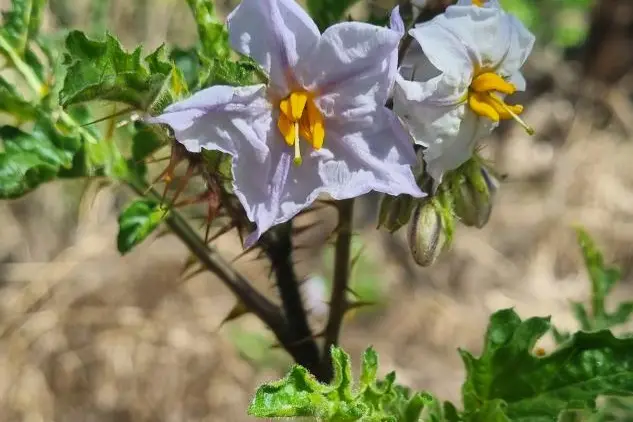
Sticky nightshade is an upright-growing plant which can grow to a height of 1.5m with prickles covering almost all of the plant, and typically flowers during spring and summer.
Leaves are sticky and green-yellow in colour, growing 5-14cm long and 4-10cm wide. They have deep lobes, hair, prickles and grow from four centimetre long stems.
Flowers grow in a star shape with five petals. Colouration is either white or blue/purple in colour, with central yellow anthers.
Prickles are yellow to red and sometimes brown on older prickles (1–10 mm long) on stems, leaves (top and bottom), leaf stalks and at the base of flowers.
Mr Jones recommends residents get to know how to identify and control it.
“Early detection is vital, regular checks are important, as the plant can flower within five weeks from sprouting,” he said.
It can manually be removed through chipping or digging out small plants and removing all of the roots. Wear appropriate protective clothing, boots and gloves to avoid injury from the prickles.
Avoid cultivating infested areas as it will move root pieces to clean areas. If it is unavoidable, remove all plant fragments and soil from cultivation machinery before moving it from the infested site.
Avoid slashing as it can spread the weed. Slashing does not control it because the berries can grow close to the ground below the slash height.
With spraying, spray plants according to the labels and permit for effective control. Thoroughly spray all leaves and stems and spray the plant from all sides if possible.
Spraying will kill the plant but not the viable seeds. Remove the fruit from each plant and dispose of appropriately to avoid adding to the seed bank in the soil.
Disposal advice can be obtained from Snowy Monaro Regional Council.