
PHOTO
THERE has been a strong local reaction to the closure of the northern section of Kosciuszko National Park as the aerial culling of Brumbies takes places.
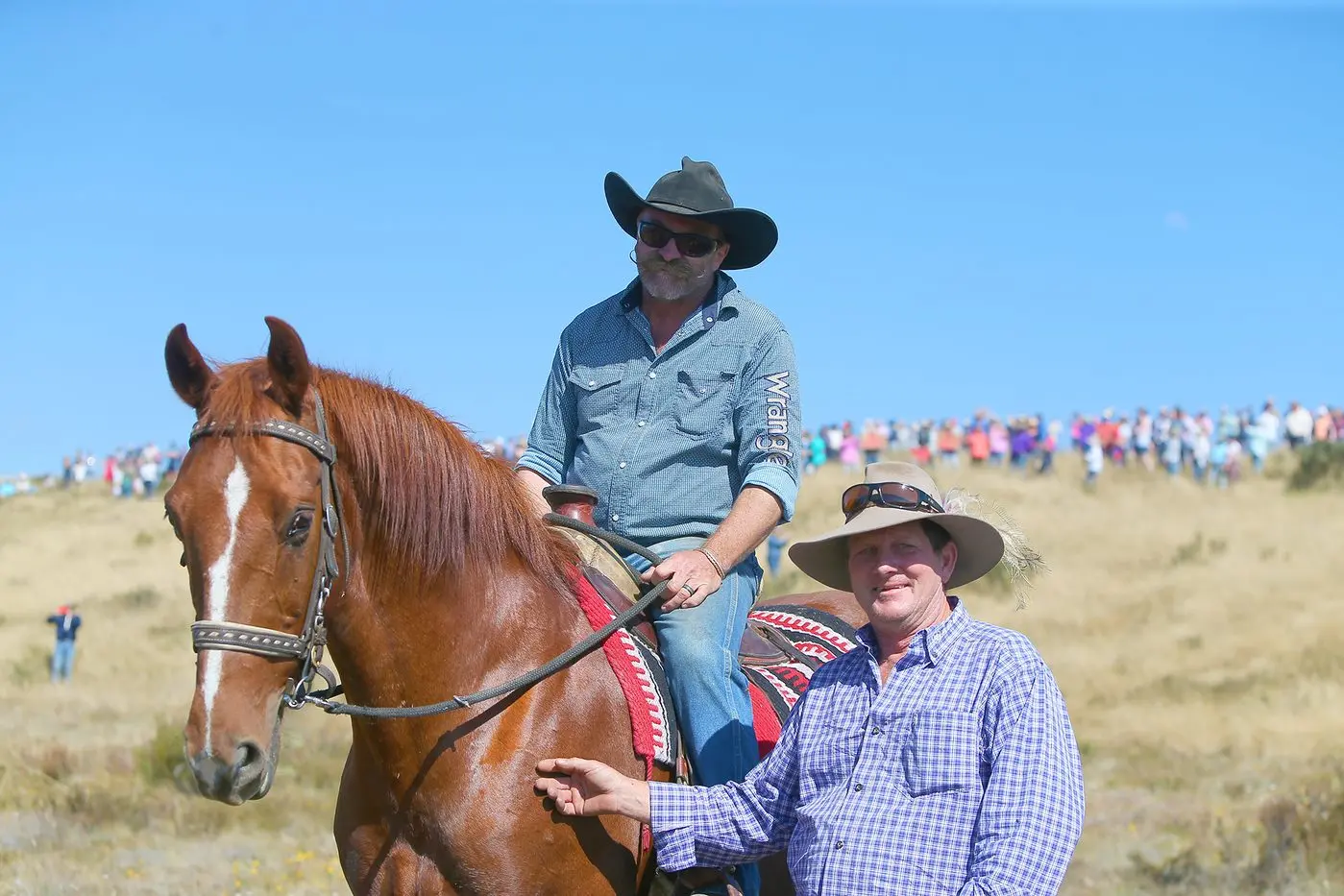
A protest against the closure of the park on Easter Sunday drew hundreds, who voiced their opposition to the culling, which many declared as ‘inhumane’.
A senior spokesperson for the National Parks and Wildlife Service (NPWS) said the estimated number of Brumbies in the park was generated using the best available science.
“There is no credible scientific evidence challenging the 2023 population estimate of 12,797 – 21,760. This estimate was generated using the best available science (distance sampling) and peer-reviewed by experts at the CSIRO and the Queensland Department of Agriculture,” the spokesperson said.
Bush poet and one of the key leaders of the Brumby protection movement, Richard Roberts, said the numbers were not biologically possible.
“National parks put the [parliamentary] committee up in a helicopter,” he said.
“They’ve got this number between 14,000 and 23,000 horses; it was an opportunity to ask how many horses they saw. The Greens member said they saw ‘hundreds’ and Emma Hurst, the Animal Justice Party member, corrected them and said they’d seen 70.”
A NSW parliamentary inquiry into aerial culling in the national park, which concluded in March, supported the estimated numbers of Brumbies.
State Minister for Environment Penny Sharpe said the government is taking a 'very conservative approach' to the numbers.
“There is a view that we could have as many as 20,000 horses in the park, and we need to continually work through that to make sure that we get down to 3,000,” she told the inquiry.
“We've already proved that [number of Brumbies are] it's over 3,000. Let's just say that there is no chance or view that there is less than 3,000 because it's already been proven not to be the case.”
Committee member and Shooters, Fishers and Farmers MP, Robert Borsak, raised his concerns regarding the large disparity in potential horse numbers.
“There’s a view that there could be as many as 20,000, even more, but there's also a view that there could be less than 3,000 there now," he asked the inquiry.
Environmental activists are concerned about the ongoing ecological damage of hard-hoofed animals in KNP.
Former NPWS ranger and organiser for the Public Service Association, Kim De Govrik, told the inquiry that introduced horses had reached a point where it had threatened the native species within it.
“We're talking about Australia [as] the ‘extinction nation’. When people get emotional and start talking about the heritage value of wild horses - not in national parks. National parks are set aside for nature conservation and recreation,” he said.
Leisa Caldwell of Snowy Mountains Horse Riders and formerly on the Kosciuszko Wild Horse Heritage Community Advisory Panel said the aerial shooting could never be considered humane.
"The last few decades of mismanagement by National Parks and the anti-horse lobby now only have themselves to blame for this ongoing issue," she said.
"We agree that the Brumbies have always needed management but National Parks need educating in that management from the horse experts.
"We strongly reject the biologically impossible numbers stated, we believe they appear to be manipulated just to justify this slaughter, even though all surveys have only ever actually physically sighted a fraction of these numbers."
We strongly reject that aerial shooting could ever be considered humane in areas of dense forested mountains.
The NSW Department of Environment and Heritage, and NSW Parks and Wildlife Services could not comment on operational activity, but in a release earlier this month, they said the closure 'is to ensure public safety during essential operations for feral animal control. This includes the use of aerial shooting,” the statement went on to say “the section to be closed is limited to 20 per cent of the Park. The winter re- sort areas are unaffected and re- main open for the season.”