
PHOTO
Medical students from the Australian National University’s School of Medicine and Psychology Rural Stream program have been welcomed to the region where they will live, train and study throughout the 2026 academic year.
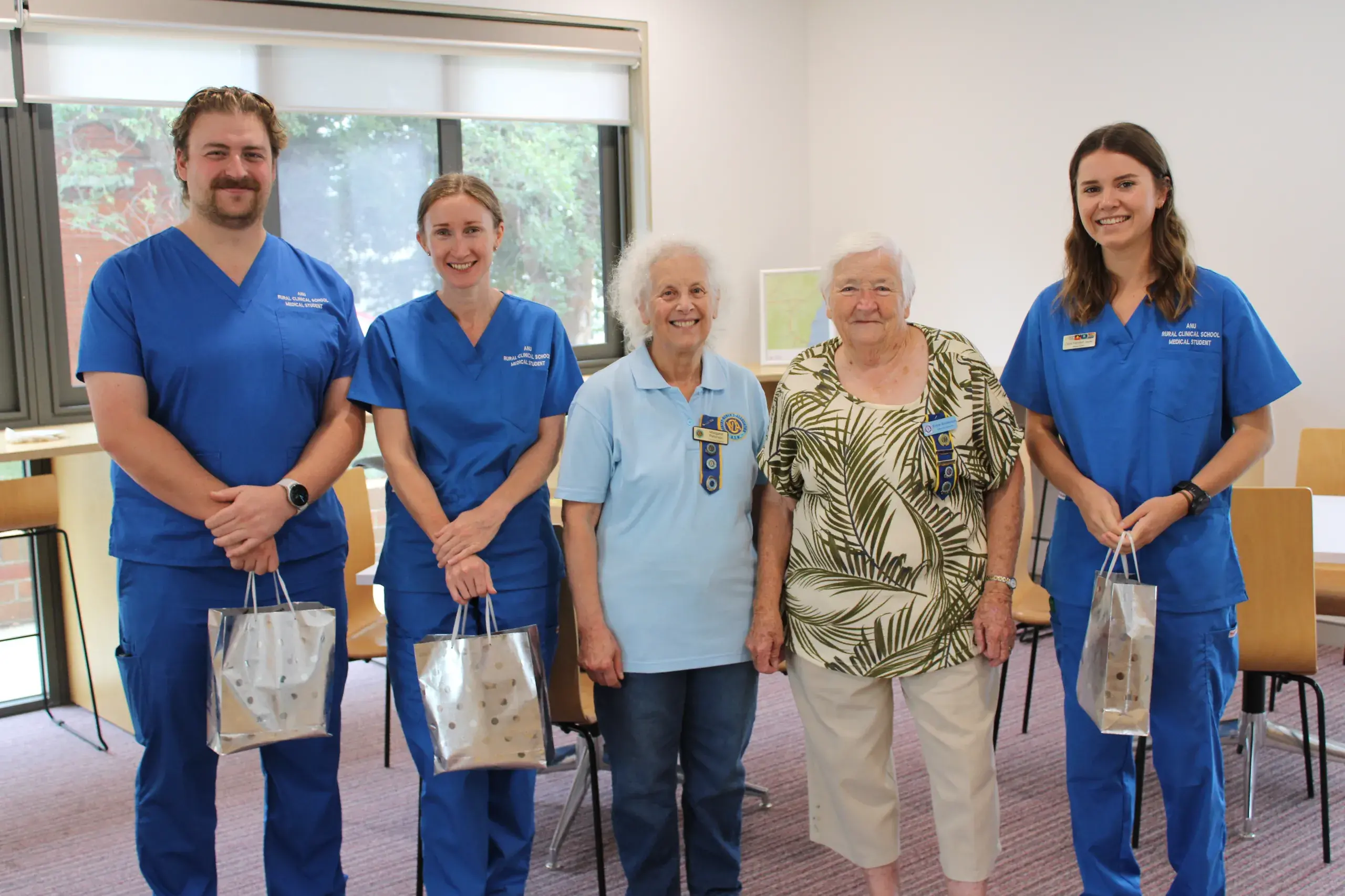
The students officially began their rural placement with a community morning tea hosted by the Cooma branch of the Country Women’s Association (CWA) at the ANU Rural Clinical School clinical training facility, reflecting the strong local support behind rural medical education.
Branch president, Margaret Peterson, and secretary, Kaye Anderson, extended a warm Cooma hello and welcome to the “best country town” in Australia, providing homemade cakes and freshly baked scones for the occasion.
Each student received a welcome gift of chocolates and a $40 Cooma Chamber of Commerce gift card, along with heartfelt encouragement to consider returning to the Cooma Health Service after completing their studies.
In addition to the CWA members, Rural Clinical School (RCS) academic co-ordinator and local GP, Dr Robert Wiles, along with RCS administrator, Georgina Dewar, welcomed the medical student group.
The rural stream program has played a significant role in strengthening Australia’s rural medical workforce, with a number of graduates returning to regional communities such as Cooma to practise following completion of their training.
The program has built a strong reputation for encouraging medical students to pursue long-term careers in rural and regional settings.
“We hope you get to know the town, meet some locals, learn a lot about rural practice and come back to work in Cooma. Country communities are where it’s at,” Mrs Anderson said.
Rural Education co-ordinator, Kylie Douch, responsible for ANU short-term Rural GP medical student placements throughout South East NSW, said providing placements across the region ensures every ANU medical student gains valuable exposure to medicine in rural and regional communities.
“Without the ongoing support of our local GP practices within our rural communities, this training simply could not happen,” Ms Douch said.
“Many students experience a ‘light switch’ moment when they work in a rural health setting. It opens their minds to continuing their education, training and professional careers in rural areas.”
Dr Wiles encouraged students to embrace the opportunities rural placements provide, noting that hands-on experience and increased responsibility significantly enhance learning outcomes.
Also attending the morning tea were four third-year students undertaking short-term, six-week Rural GP placements.
The CWA members, along with Dr Robert Wiles, did their very best to sell the benefits of living and working rurally to the students.
“We have some movers and shakers in this region, and a town of go-getters, it’s a very exciting place to live,” Dr Wiles said.
As an example, the Monaro Committee for Cancer Research (mcCr) and its community achievements was mentioned.
Dr Wiles said the group has raised millions of dollars to assist with the provision of medical facilities and services in the local area.
“Because of this group and its amazing members we have an oncology unit and a renal unit, and now they are fundraising to build a new oncology unit.
“They don’t know that you can’t do the impossible, because they do it all the time. It is an amazing group,” Dr Wiles said.
“In any country town, you can do the same - you just have to have a vision, and you have got to have the drive, and this group has both.”
Mrs Anderson said it will be 18 years in September since the current oncology unit was opened.
“Everybody here should go to the oncology unit before they leave the area,” Dr Wiles said.
“It’s a nurse-led unit, the first in Australia, and they said it couldn’t be done and the mcCr bull-dozed all the politicians and did it anyway, and it’s now been rolled out across Australia as the model for rural specialty unit. The renal unit is the same.”
The efforts in the health sector by local resident and former NSW Minister for Rural Health, Bronnie Taylor, were also acknowledged.
Dr Wiles also praised the work of the Cooma CWA which is celebrating 100 years at the end of this year.
“The CWA was instrumental in organising childhood immunisations when I was a child and through to the 70s and 80s before Community Health stepped in,” Dr Wiles said.
CWA was also involved with maternity and baby health centres in the rural areas, plus school hostels for students who lived too far from the schools to travel in each day.
“They are the sort of things that were established by the CWA, as far back as the 1920s, before social services were provided by government,” Mrs Anderson said.
Issues such as health, transport, education, aged care are still covered by the CWA at its statewide conferences and put forward to governing bodies.
“There are many people in your district if you join a rural practice who will be making a difference you just need to plug in to them and join forces. It’s amazing what you can achieve,” Dr Wiles said.
The long-term students expressed their appreciation for the warm welcome and generous support from the Cooma CWA branch and said they are looking forward to immersing themselves in rural medicine and becoming part of the local community over the coming year.