
PHOTO
The Snowy Monaro region, known for its beauty, picturesque towns, villages and localities, close community connections and appealing rural lifestyle draws people from all walks of life to settle in the area.
In one of the most unlikely of places, the locality of Bungarby has a couple of hidden gems living off the beaten track, close to the banks of the Snowy River.
For world class artist, Tonia Ganin, this has been home for the past seven years.
Born in Harbin, China to Russian parents, Tonia and her family immigrated to Australia in 1961 when she was 13 years of age.
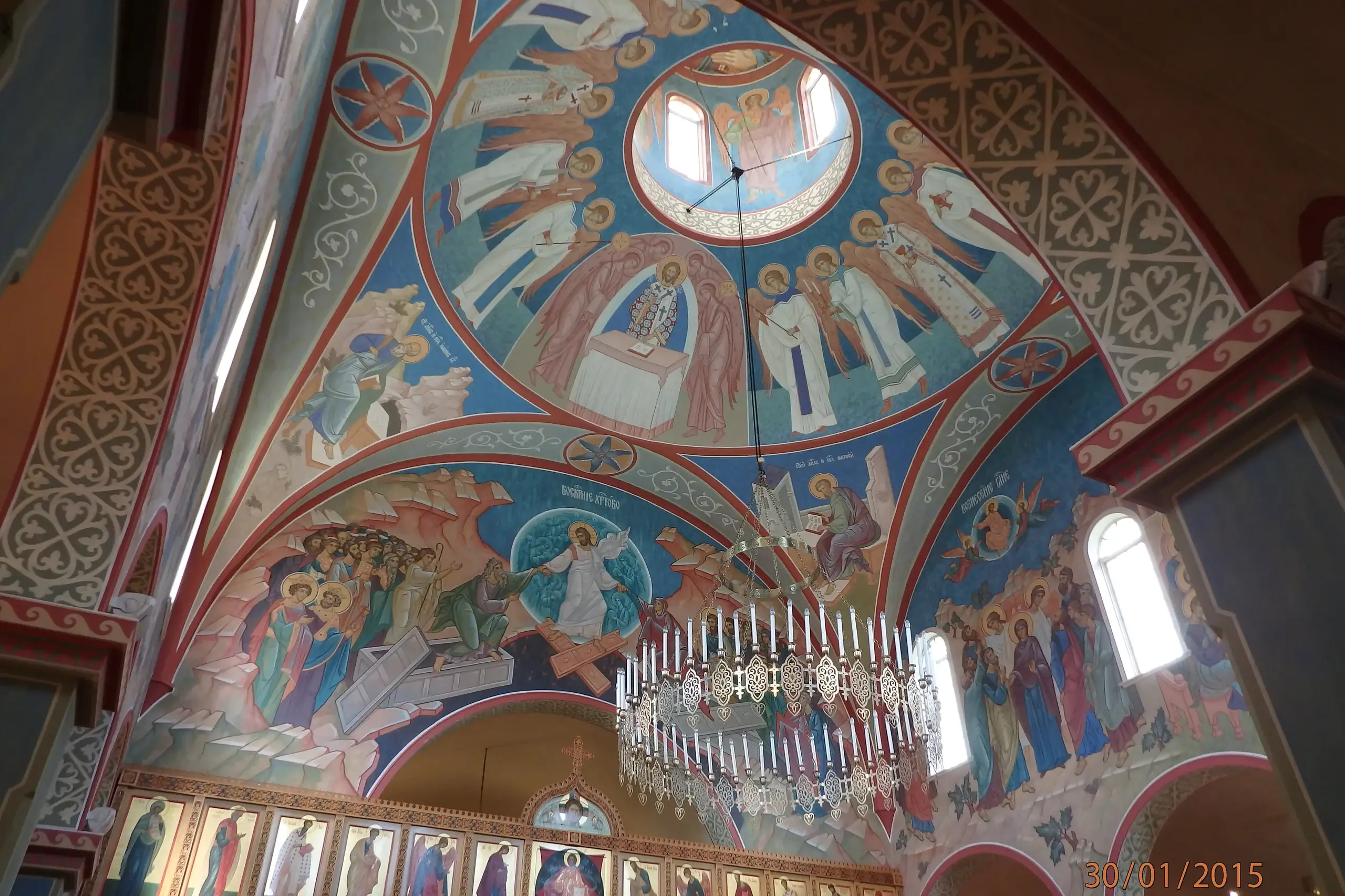
Tonia is a highly regarded and respected artist in traditional iconography, Russian Byzantine frescoes and sacred art - rare art forms in Australia.
“Not many people do this style of painting, it did have a resurgence and it is becoming more popular in Greek Church, Europe and Russia and for some artists in America,” Tonia said.
Iconography, or art of the icons, or holy images, is a sacred art which originated and developed within the Eastern Orthodox Church. The purpose from the beginning was ‘service to the church’. It was spiritual, the icon, (or holy image) was to inspire and educate the viewer and to immerse them in mysteries and teachings of the church. Therefore, the style had to be appropriate for this purpose and reflect other worldliness.
The icon is considered a window into Heaven.
The first icons appeared in catacombs in Rome - a place where Christians were meeting secretly (due to persecutions during first three centuries) to celebrate Eucharist.
First images depicting Christ, Virgin Mary, and the apostles painted on walls, rudimentary and simplistic, were Roman in character.
But as time went on, iconography gradually developed into a distinct style which varied from epoch to epoch.
Mainly after the 10th century this cycle and the types were more permanent and maintained similarity throughout the Byzantine Empire. Thus, it is called Byzantine style of iconography. It continued to develop until the 17th Century, the peak being the 15th and 16th Centuries.
The style was distinct, where representation of figures, faces, landscape and architecture were stylised, symbolic and not naturalistic: perspective was not observed, bodies and facial features elongated with large open eyes, all looking into the celestial world.
The churches were decorated with frescos and mosaics depicting Christ - Pantocrator (Ruler of all), Holy Virgin, events of the Gospel and main feasts of the church.
There were also panel icons painted on wooden boards using egg tempera medium, which was very ancient and dates to the pre-Christian era.
For Tonia to take part in this form of art, it was a long and meandering journey: firstly, art in high school, then studying graphic art at East Sydney College, then several commercial arts jobs, including designing greeting cards at John Sands and Valentine.
She then found her passion for iconography.
“I soon realised I didn’t know much about it, so Michael and I and our children, who were very young at the time, went travelling around Europe for six months to learn more and bring what I learned back to Australia,” Tonia said.
“In New York State I was permitted to live near Jordanville Monastery and take lessons from the elderly iconographer, who was considered to be the best expert.
“He taught me in the beginning, and I also did much of the learning myself using all their resources, and books. While there I met a colleague, one of the monks.
“Together we developed a technique of using egg tempera, a very traditional method.
“We continued to extend our knowledge, and with more travel, learning from Russian iconographers - we developed our own technique and method of egg tempera and have maintained it ever since.”
Tonia said egg tempera is very specific, made up of dry powdered pigment mixed with egg yolk and wine emulsion on a glass plate using a glass muller.
“We use mineral pigments, that is natural clays and powdered mineral rocks like lazurite, malachite, cinnabar, etc. They are crystalline in structure and reflect light, which draws your attention. Some rocks were collected in the Australian desert.”
Tonia adapted her technique further; instead of painting each scene separately within a border, as is usually done, she paints continuous scenes on canvas panels giving the frescoes a sense of spaciousness. It also adds a significant degree of technical challenge to the artist.
Tonia paints all styles and mediums. However, her specialty is the ancient art of iconography. Her work is highly technical and detailed, her skill flawless.
Her paintings are artistically magnificent, captivating and celestial; whether it be restoring an icon image on a small piece of wood or being commissioned to paint a church full of ceiling and wall murals which rival the stunning, historic cathedrals of Europe.
Tonia has decorated three churches in Sydney, one in Adelaide and one in Melbourne with stunning fresco images.
Some of Tonia’s work can be observed in the Russian Orthodox Holy Protection Cathedral in Brunswick, Melbourne - one of her more recent projects - and the Holy Protection Cathedral (Russian Orthodox Church) in Cabramatta, NSW, a project she started in 1980 with a colleague. They covered the entire interior with traditional iconography, further enriching the church’s spiritual and artistic significance.
Then there were two Serbian Orthodox churches, a small, St Lazarus church which was painted together with her daughter, Sasha, who is also fully trained and has produced excellent work, and a huge church, St Sava’s, in Ingleside, NSW.
“It’s becoming very difficult as I get older,” Tonia said.
“I am now 77 and have slowed down a lot.
“I’ve been painting most of my life and now have a problem with my hand from years of painting.
“It’s also a big spiritual and physical effort to take on the large, commissioned projects.”
Tonia moved to Bungarby from the Bega Valley in 2019 a few years after husband, Michael, died. Their adult children and grandchildren live in city environments, which at this point in her life, Tonia prefers to stay away from.
Bungarby is a peaceful place for a reclusive artist’s retreat.
Her 200-acre property originally included an old farmhouse and a few outbuildings. One of the first improvements Tonia made was to renovate the house, then add a large shed.
The new shed is purpose-designed to contain her art studio; a creative space where Tonia can produce her works and teach her craft.
Her property is also close to The Presentation of the Mother of God Orthodox Convent, a female monastery founded in 1999, situated on 600 acres with the Snowy River on its doorstep. The sisterhood is another one of Bungarby’s little-known facts.
When she is not painting, Tonia spends much of her time there. The convent superior is Tonia’s sister, abbess Anna, but all the nuns who live there are family to one another.
Three of them are under Tonia’s expert tuition as they learn the intricacies and techniques of sacred art.
Nowadays Tonia is kept busy instructing the nuns in this ancient painting style.
“Teaching iconography is a long process, but my students are very gifted, and I am very happy that this art will not die with me,” Tonia said.
“The basis of iconography is a human body, so they have to understand... I use aids to teach them to draw such as a skeleton; they need to know how to draw body parts, the anatomy of hands and feet, the head and face.
“Then we will gradually move into actual painting, using all their knowledge, they are learning the stylisation of it; so it’s very involved," Tonia said.