
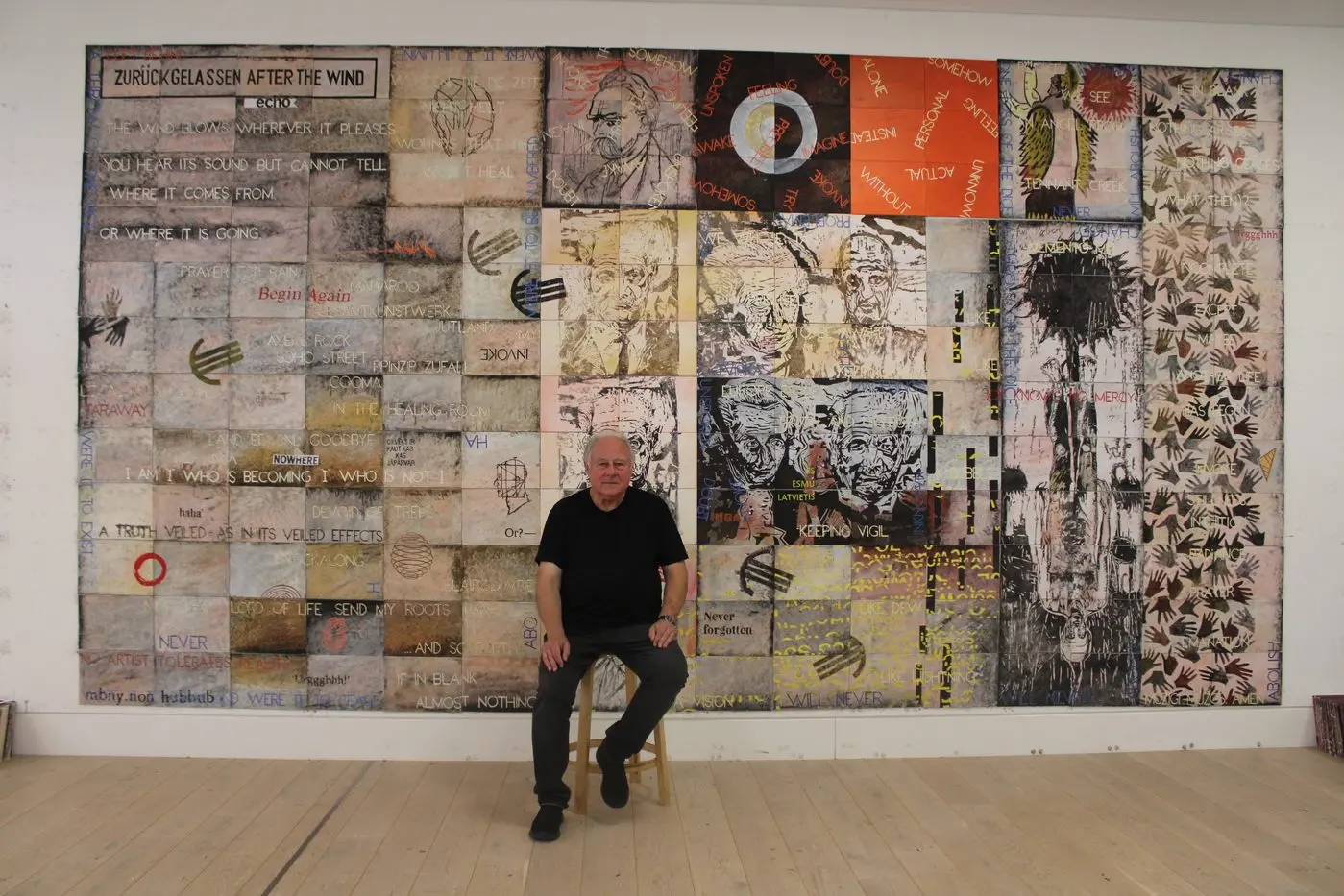
PHOTO
IMANTS Tillers is having trouble talking about himself. Almost as much trouble as sitting still. Or, smiling for a photograph. He poses under sufferance.
The world renowned, but reclusive Cooma artist, writer and curator is quite uneasy about the interview process.
He is modest, introverted and focussed. Restless, on the move from chair to table to unfinished art works scattered around his palatial studio and back again.
His mind not 100 per cent on the interview, but constantly mentally planning his next artwork.
Glancing constantly at wife Jenny, telepathically begging her to answer the questions for him.
Imants doesn't like having attention on himself or his many achievements.
But once he has a paintbrush in his hand, a work of art in his line of sight, or his beloved wife of many years by his side, the Raglan Gallery patron comes alive and speaks passionately about his favourite topic and when prompted, his upcoming exhibition in Germany.
Is he eccentric? Possibly.
Brilliant? Absolutely.
Friendly? Yes.
Likeable? Very much so.
Fascinating? Hugely.
A great role model for other artists? Yes.
He loves to encourage talented artists to follow their dreams. He is proud to be a patron of the local art gallery, but believes he is not a 'good' patron, because "I am not around much".
Imants has presented Australia at significant international exhibitions such as the Sao Paulo Biennial (1975), the Biennale of Sydney (1979, 1986, 1988, 2006), Documenta 7 (1982) and the Venice Biennale (1986) after coming to prominence during the early 1970s and has been at the forefront of conceptual art and postmodern discourse in Australia.
He works primarily with appropriation, intuitively combining existing artworks, philosophy and literature as 'ready-made' poetry in his imagery.
At the moment he is busy preparing for his exhibition in Germany in October, a country of special significance to him and has exhibitions in Hobart, Melbourne and New York.
His daughter, Isidore, and her husband, Blake, have set up the German exhibition, Remembering the Unknown, which he is excited about because of his Baltic heritage.
"Latvia was run by German barons for 800 years and my heritage is Latvian," he said.
His focus is now on the forthcoming Archibald Prize at the Art Gallery of NSW in Sydney.
"Sixteen-year-old Dakota Clarke wants to do a portrait of me," he says when asked if anyone has ever painted his portrait.
"She is the daughter of a friend of our book keeper, a keen portraitist who wants to enter the Raglan Gallery's competition, where artists submit portraits of Snowy Mountains local people for an exhibition in June/July.
"I was thinking about it and now I have agreed. I have rejected a few requests. But I like to support the young ones."
He would make a good subject. When his face crinkles into a smile, it comes alive; an artistic study in its own right, a physical story of a life well-lived and well spent.
In 1996, Imants' portrait was painted by the renowned Australian painter, Dick Watkins, and was hung in the Archibald.
Imants himself has been a finalist in the Archibald some six times. One of his most recent entries, The Emergency of Being 2018, is now in an important private museum in Riga, Latvia.
Like most of his other works, it uses a lot of text.
Imants is a keen writer as well as painter and he loves to insert words into the images.
In 1989, his photo-mechanical reproduction, My Wife as An Apparition, was also hung as a finalist in the Archibald.
"Recently I was inspired by Christopher Bollas the British psychoanalyst and writer who questions the nature of self.
"One of my favourite texts is, 'there is no whole self'. And I've quoted from Bollas recently: 'The Selfless self of self'.
"Also I identify with the world renowned artist Louise Bourgeois who described the anxiety void which is central to her work. I also work a lot in the anxiety void."
Imants was born in Sydney in 1950 from parents who had come to Australia from Latvia as displaced persons the previous year.
"You would call them asylum seekers now," he says.
"They had met and married at a displaced persons camp in Germany and had to pay for their passage, but were sponsored by the Australian Government.
"They settled in Sylvania Heights and my father was a labourer and mum was a helper for a doctor to repay their debt."
Imants reckons he was born an artist.
"As a kid I drew. Given my background I had a lot to express. I was mentored by landscape artist and TV presenter (William) Bill Salmon and at 15 was on the ABC TV 'On The Inside Show' in the 1960s," he said.
Imants' father wasn't all that keen on his son becoming an artist.
"He said if you became an artist you end up in the gutter, so I studied architecture for four years at Sydney University to appease him."
He was conscripted for Vietnam in 1969 when he was 18 but did not have to go as he was at university, after which time the Whitlam government abolished conscription.
"In the end I gave up architecture and began life as an artist," he said.
"In 1969 I got the opportunity to work on the Christo Wrapped Coast at Little Bay project."
Christo Vladimirov Javacheff and Jeanne-Claude Denat de Guillebon, known as Christo and Jeanne-Claude, were artists noted for their large-scale, site-specific environmental installations, often large landmarks and landscape elements wrapped in fabric.
Wrapped Coast, One Million Square Feet, Little Bay, Sydney, Australia, 1968–69, was Christo and Jeanne-Claude’s monumental work of art created for the coast and cliffs of Little Bay near Sydney, Australia.
The artists, working with project co-ordinator, John Kaldor, (Wrapped Coast was the first in a series by Kaldor Public Art Projects) and Major Ninian Melville (retired Army Corps of Engineers), assembled and directed a team of 15 professional rock climbers and 110 local art and architecture student workers, as well as Australian artists and teachers.
Over a period of four weeks, they wrapped about one and a half miles of coast and cliffs up to 85 feet high with 1,000,000 square feet of light beige erosion-control fabric and 35 miles of rope.
That meeting proved to be a turning point.
In 1978, Christo was back in Australia and Imants was teaching at Sydney College of the Arts.
"He was amazed to meet one of his volunteers who had become an artist and we became friends and the next year I stayed in his apartment in New York, with Jenny whom I had met at Sydney University, and it just went from there," Imants said.
The couple has been married for 50 years and has two children and two grandchildren. Jenny, Imants says, is his rock, his manager and his greatest supporter. Not to mention, often his voice.
Imants had his first show in Sydney in 1973 and has continued to paint and exhibit all around the world without any real career focus or planning. He secured a New York gallerist and did five solo shows in New York in the 1980s.
His current style of painting large 2.5 metre by 3.5 metre works on 10 inch by 15 inch tiles came about when his studio was his spare room and he had to work out how to create large artworks that would fit out the door and could be sent all around the world by post.
He paints on multiple canvas board panels which fit together to form large, gridded works and the individual boards are numbered from one towards infinity and are considered to be part of a continually-expanding whole, collectively titled the “Book of Power”.
The paintings have explored a range of themes over the past four decades including authorial originality, the reproduction and distribution of images, diaspora and displacement, landscape and place, and metaphysics.
In the 1980s Tillers was one of the first artists to engage with Aboriginal art as a contemporary genre (sometimes controversially) and his recent work considers the unexpected resonances between Aboriginal art and European metaphysical painters such as Giorgio de Chirico.
"I very much do my own thing and am never stuck for ideas," he said.
The couple came to Cooma in 1986 and he exhibited at the Raglan in 1996 for the first time.
They moved after finding the perfect home, when their children were five and 11, and he was inspired in his art by the landscapes he passed when travelling around for exhibitions.
His Monaro souvenir masterpiece hangs in the foyer of the Raglan Gallery in Cooma, on Lambie Street, as his gift to the community.