
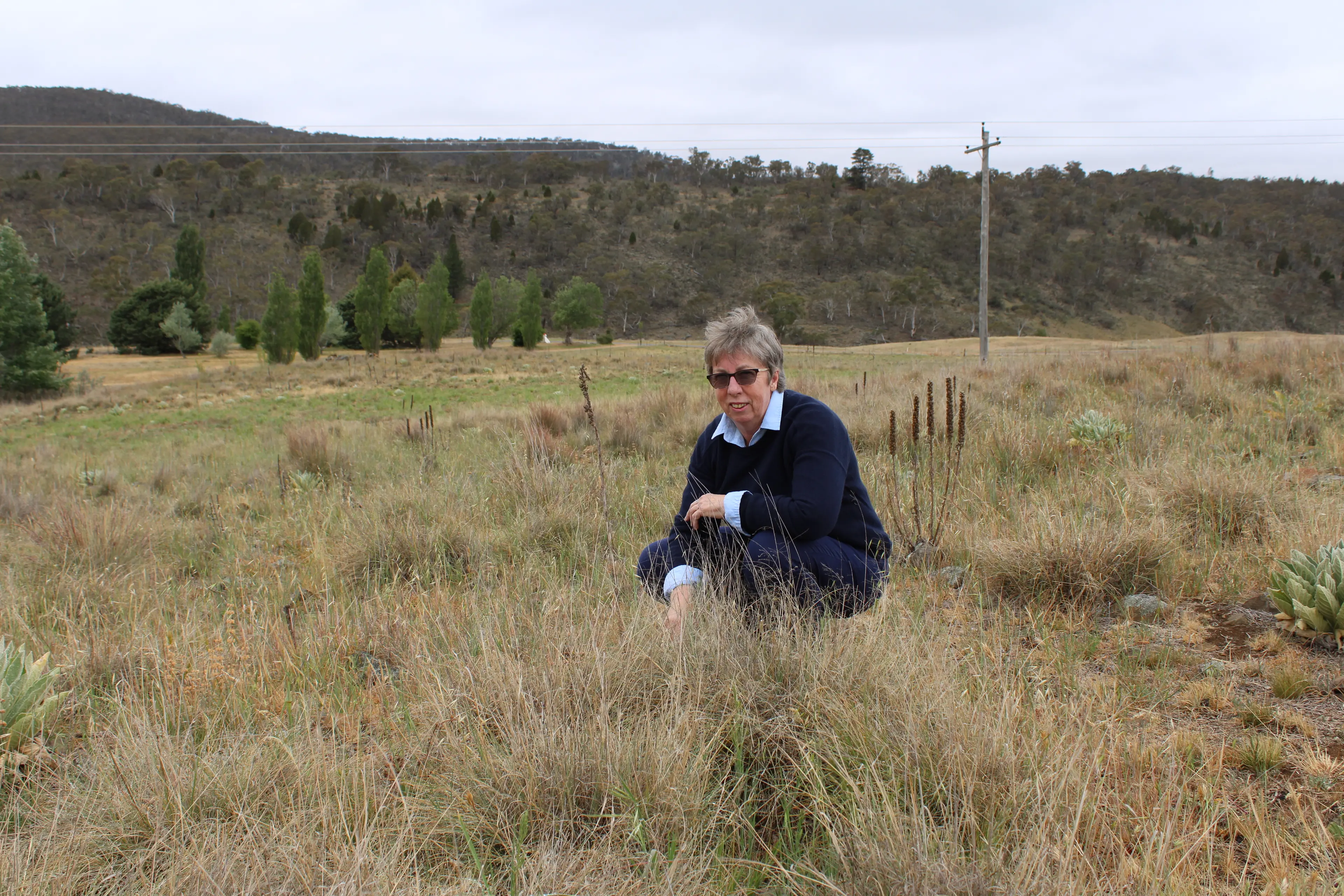
PHOTO
Since December 2023 there has been a small, dedicated group of locals working together in consultation with the state and federal governments towards one goal - to try and slow the progression of African Love Grass (ALG) south of Cooma.
The working group in this time has had meetings with Member for Monaro, Steve Whan, the NSW Agriculture Minister, Tara Moriarty, the NSW Environment Minister, Penny Sharpe, the Natural Resource Commission (currently reviewing the NSW Biodiversity Conservation and the Local Land Services Acts) and federal Member for Eden-Monaro, Kristy McBain.
The group is made up of representatives from Upper Snowy Landcare, South East Local Land Services, Snowy Monaro Regional Council, NSW Farmers Monaro branch, individual landholders and farmers, agronomists and environmentalists.
Farming community representatives include landholders who have been battling lovegrass incursion and spread for more than 40 years.
“The aim of our group is to try to keep clean country clean across the Monaro, noting the Monaro is significantly different to many other areas of NSW where we have predominant native grasslands which are highly valued - and under the Environment Protection and Biodiversity Conservation (EPBC) Act are critically endangered - and our terrain does not allow for widespread cropping that happens in the west and central west of the state,” working group chair, Narelle Davis, said.
The inconsistencies between the federal EPBC Act (currently under review), the Biodiversity Conservation Act in NSW and the Local Land Services Act, is one of the main focusses of the group. The acts need to be consistent between state and federal Departments of Energy, Environment, Climate Change and Water (DEECCW) with one point of approvals.
“One of the issues many landholders have experienced is the inconsistencies between the acts. That inconsistency does not give landholders confidence around their ability to undertake productivity measures on their land, as they would like,” Mrs Davis said.
“The NSW Biodiversity act requires assessment and approval for clearing of previously undisturbed landholding that have greater than 50 per cent native grasses. Many landholders do not know that they also require approval from the federal DEECCW. Landholders can be reported and penalised if approvals not in place. Unfortunately, ALG is difficult to manage when this weed is dominant in a paddock. Spot spraying is time consuming and costly. Currently even though it is every landholder’s responsibility to manage weeds, there’s no penalty if you do nothing.”
ALG is a major and critical threat to the native grasslands of the Monaro region, which is classified as non-woody vegetation.
The invasive monoculture has spread from about 3000 ha in 1986 to more than 100,000 ha in 2020.
“Lovegrass is the most pre-dominant weed on the Monaro north of Cooma. The spread is also quite noticeable around Dalgety, Jindabyne, Cooma and some of the other villages; and the spread rate is accelerating,” Mrs Davis said.
“ALG is a sub-tropical (C4) plant. It is very well suited to our Monaro environment, cold winters, random summer rains. It is very water efficient so will grow huge bulk of dry matter very quickly and can set seed multiple times over the summer.”
ALG is an extreme fire hazard due to the highly flammable dry matter it produces.
“Communities will burn if it is left unchecked; vulnerable ecological communities will burn if left unchecked,” Mrs Davis said.
These include koalas, wombats, legless lizard, native grasses and forbs.
After meeting in April with the Natural Resource Commission, members of the Snowy Monaro African Lovegrass working group met with delegates from DEECCW in Cooma in August.
The working group spoke about the impact ALG has on the Monaro, potential control measures and proposed resolutions.
“We spent a really interesting day with DEECCW,” Mrs Davis said.
“We put our case forward around the fact we need to have consistency in the legislation and also any approval processes etc. This message has gone back to federal Environment Minister Murray Watt and is being debated in parliament at the moment.”
A complete infestation of ALG reduces productivity by 75 per cent.
During a site visit, the local host landholder showed the DEECW delegates a medium-value native grassland paddock which had caused conflict with the law for boom spraying a portion that was infested with ALG.
The working group members highlighted to the government department that farmers are on the front line in defending the Monaro native grasslands and to continue to do this, they need to be profitable.
“The paddock the government department representatives observed is costing the landowner $300/ha each year to spot spray ALG, while he only makes $30/ha per year income,” one of the working group members, Ant Waldren, said.
“However, the neighbour’s paddocks have mass infestations of ALG, which they are doing nothing about and costing them nothing to do so,” Mr Waldren said.
Mrs Davis said protecting the high value native grasslands of the Monaro treeless plains is of paramount importance to the community.
The working group believes 40 years of successive biosecurity and diversity regulations has not worked; with 5000 seeds per plant, 10,000 plants per hectare it’s become a real threat to the agricultural industry and compounds the risk of a fast-moving wildfire.
“The current regulations contradict each other and are inflexible where it matters,” Mrs Davis said.
“The regulations in the act/s prohibit, viable control methods, thereby threatening the Monaro Native Grasslands and inhibit effective measures to best manage ALG.”
The working group has advised halting and reversing biodiversity loss requires a grassroots approach.
“The current method of herbicide use, without follow up pasture establishment, is counterproductive as it reduces ground cover and assists lovegrass spread due its C4 characteristics,” Mrs Davis said.
“To slow the progression of lovegrass into our clean and most valuable agricultural and naturally significant country on the Monaro all the key agencies are working together with the community.
“It’s a complex process. We want an outcome that can support conservation of the temperate native grasslands but allows landholders to be productive and manage endemic weeds effectively.”