
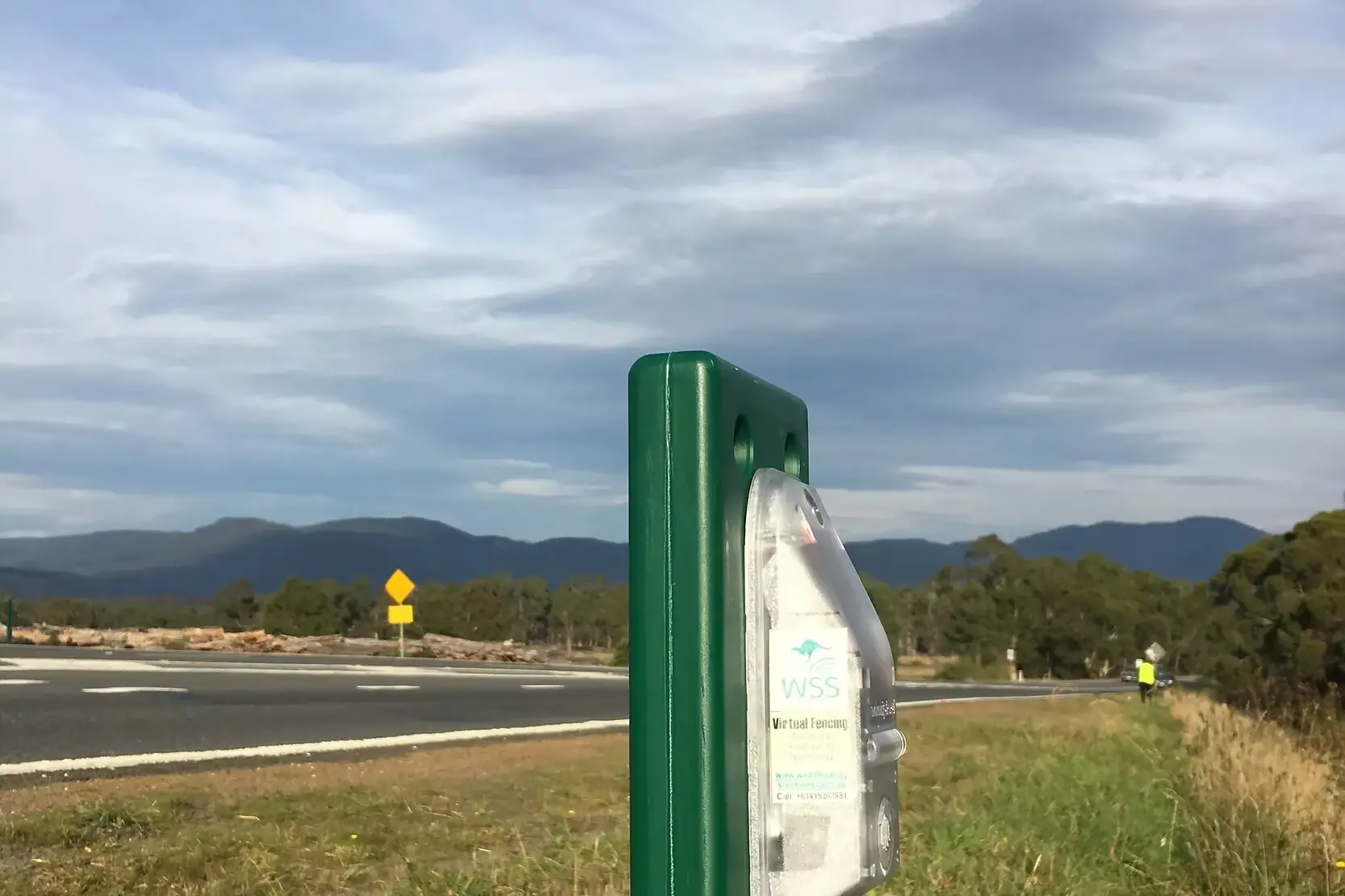
PHOTO
A meeting last month between NSW government representatives and the local resident behind a push to improve the safety of the Monaro Highway from wildlife collisions has proved beneficial with those in attendance stating they are open to investigating options.
Organised by Member for Monaro, Steve Whan’s office, the meeting included linking in a representative from Transport NSW along with representatives from Mr Whan’s office and a representative from the NSW Transport minister’s office.
According to the proposal campaigner, Ted Streatfeild, the meeting was positive with attendees indicating support for the call to improve the safety of the Monaro Highway from wildlife collisions.
“Transport NSW advised they had a trial of Artificial Intelligence (AI) signs that alert drivers when there is wildlife approaching the road,” Mr Streatfeild said.
“I am advised that the trial is between Michelago and Bredbo and I understand that it may be programmed to identify native species. The trial involves installing AI signs that turn on when the sign senses animals near the road.
“While I commend the trial of something new and innovative I am not confident that the AI signs will make a significant difference over time.”
Mr Streatfeild said he envisaged some drawbacks in the AI technology.
“Traditional wildlife signage when first installed was somewhat effective but then effectiveness wore off as people got used to the signs while traveling at a constant 100km an hour and now largely ignore them. The same fate may befall these AI signs once people are used to seeing them and do not want to slow down.”
Mr Streatfeild has requested Transport NSW provide more information regarding the start of the trial, the equipment to be used and the number and expected cost of each unit and whether or not the AI signs would deter the wildlife from entering the road; he has not yet received a response to these questions.
“Meanwhile we continue to push for an extensive trial with the combination of the use of the latest developments in virtual fencing and hard fencing,” he said.
“Virtual fencing has proven very effective as a deterrent for kangaroos and wallabies and does not rely on triggering the drivers motivation to slow down.”
Virtual fencing technology has had proven application in the US and Europe, on wildlife of all species and sizes, since 2003. However, as a new product to Australia, its effectiveness on Australian wildlife and in Australian conditions has only recently been confirmed.
The virtual fence uses the latest non-invasive audio and visual systems to alert animals and prevent vehicle contact.
Virtual fencing made its Australian debut in Tasmania where the technology is utilised to help protect the vulnerable Tasmanian devil.
Locally, Wildlife Safety Solutions virtual fencing was installed on Old Bega Road, Greenlands (Nimmitabel) in March 2020. Animals targeted along this two kilometre stretch of road include wombats, wallabies and all other native fauna.
Charles Sturt University trialled this virtual fencing in the Snowy Monaro region in an effort to improve the conservation of wombats.
In 2022, Eurobodalla Shire Council was the first council in NSW to implement virtual fences to protect animals from cars.
“I have spoken with a representative from Wildlife Safety Solutions who can provide some input into providing virtual fencing suitable for a trial on a 100km an hour highway,” Mr Streatfeild said.
“Despite the lack of information on virtual fencing in the Transport NSW report on using technology to reduce wildlife collisions, virtual fencing has been the most effective existing technology available for deterring wildlife from several trails and local council installations in Eurobodalla and Tasmania.
“It would be good to see a virtual fencing trial from Canberra to Michelago and from Bredbo to Cooma alongside the AI signage trial and compare their effectiveness.”
Mr Streatfeild said virtual fencing is not as effective on wombats though.
He believes for native animals such as wombats, hard fixed fencing with underpasses at key locations is the most effective method.
“The cost is expected to run into millions of dollars to do the job properly. We would like to see a co-operative effort from the ACT government, transport and environment, NSW transport and environment and the federal government.
“Considering the number of collisions on this highway each year and the cost of the average insurance claim being around $6000 and ever rising, including the cost of vehicle insurance premiums, the amount appears quite justifiable and may pave the way for improving other animal collision hotspots,” he added.
Hard fencing materials such as slab mesh set in concrete footings that diverts wombats to under road crossings, is his suggestion.
A full trial on the Monaro Highway between Canberra and Cooma is urged by Mr Streatfeild, who is also seeking the further support of Transport NSW and Mr Whan’s office to contact the NSW/ACT Cross Border Commissioner and the Minister for Transport in the ACT, Chris Steel, to develop a co-operative effort to cover the entire stretch from the edge of Tuggeranong in Canberra to the outskirts of Cooma.
“Our next steps are to contact the ACT minister’s office; the Cross Border Commissioner; federal member for Eden-Monaro, Kristy McBain; and NSW Minister for Roads and Regional Transport, and ask for their support.”